
Understanding Reynolds Number
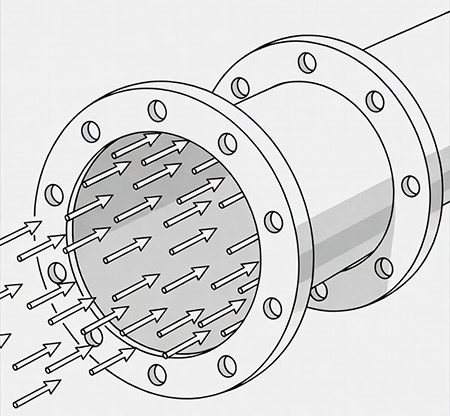
The Reynolds number is a fundamental dimensionless quantity in fluid mechanics that describes the ratio of inertial forces to viscous forces in a fluid flow. It is widely used to predict flow regimes, helping engineers and researchers determine whether a flow will be laminar, transitional, or turbulent. Knowing the Reynolds number is essential for designing pipelines, pumps, ducts, and other fluid systems accurately.
Importance of Calculating Reynolds Number
Accurate calculating Reynolds number allows you to:
- Predict flow behavior and identify turbulence or laminar conditions.
- Optimize fluid transport systems for efficiency and safety.
- Ensure precise design in computational fluid dynamics (CFD) simulations.
For example, in a pipeline carrying water, a low Reynolds number indicates laminar flow, which results in smooth, predictable motion. A high Reynolds number indicates turbulent flow, which can increase frictional losses and mixing, important for heat exchangers or chemical reactors.
How to Use the Reynolds Number Calculator
Our Reynolds number calculator simplifies the process of determining the Reynolds number for various fluids. Here’s how to use it:
- Select a fluid from the dropdown list or choose Custom to enter your own density and viscosity.
- Enter the fluid velocity (V) in meters per second.
- Enter the characteristic length (L), such as pipe diameter or channel width, in meters.
- Select the type of viscosity: dynamic (μ) or kinematic (ν).
- Click Calculate Reynolds Number to see the result instantly.
The calculator will display the Reynolds number, allowing you to quickly determine whether your flow is laminar, transitional, or turbulent.
Why Use This Reynolds Calculator
This Reynolds number calculator is a practical tool for engineers, students, and researchers working on fluid systems or CFD simulations. It provides a fast, accurate way of calculating Reynolds number without manual computations, ensuring consistent results for design, analysis, and simulation tasks. Using this tool saves time while improving reliability in fluid flow predictions.
About CFD Vision
For CFD consulting services, advanced heat transfer simulations, or customized engineering solutions, visit our main page.
Related Links:
Multi-Layer Total Heat Transfer Coefficient Calculator for Convection and Conduction
Nusselt Number Calculator for Convective Heat Transfer.