
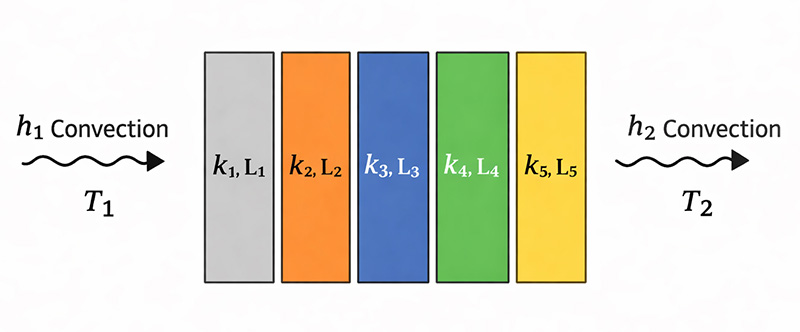
Quick answer
U = 1 / Rtotal, with Rtotal = 1/hleft + Σ(ti/ki) + ΣRcontact + 1/hright. Each solid layer adds a conduction resistance t/k; each fluid side adds a convection resistance 1/h.
The heat flux through the wall is then q = U·ΔT, where ΔT is the temperature difference between the two fluids (or surfaces).
Total heat transfer coefficient calculator
Accurately determining heat transfer in multi-layer systems is essential for engineers, researchers, and students working on thermal management, HVAC design, and energy systems. CFD Vision provides this Total Heat Transfer Coefficient Calculator to reliably calculate total heat transfer coefficient for multiple solid layers while accounting for conduction through materials and convection at fluid interfaces.
With this advanced Heat Transfer Coefficient Calculator, you can also compute the total thermal resistance, helping you optimize material selection and thermal design efficiently.
If you need this kind of analysis for a real design, our Sydney-based CFD consulting team supports engineering firms and manufacturers across Australia, from scoping to final report.
How to Use the CFD Vision Heat Transfer Coefficient Calculator
This Convection and Conduction Heat Transfer Coefficient Calculator is intuitive and professional. Follow these steps to effectively calculate total heat transfer coefficient:
- Select the Unit System: Choose Metric (m, W/m·K, W/m²·K) or British (ft, Btu/h·ft·°F, Btu/h·ft²·°F) units.
- Specify the Number of Solid Layers: Supports 1 to 5 layers of materials.
- Enter Material Properties: Select a predefined material or input a custom thermal conductivity value.
- Set Thickness: Enter the thickness of each layer.
- Include Contact Resistances: Input interface thermal resistances between layers if needed.
- Add Fluid Convection Effects: Optionally include convective heat transfer coefficients for fluids on either side of the wall.
- Click “Calculate”: The calculator generates the overall heat transfer coefficient (U) and total thermal resistance (R_total) instantly.
Equations Used in the Multi-Layer Heat Transfer Calculator
The Total Thermal Resistance (R_total) is calculated using:
R_total = 1/h_left + Σ(thickness_i / k_i) + ΣR_contact + 1/h_right
Where:
- h_left, h_right = Convective heat transfer coefficients of fluids in contact with the wall
- thickness_i = Thickness of layer i
- k_i = Thermal conductivity of layer i
- R_contact = Contact resistance between two layers
The Overall Heat Transfer Coefficient (U) is:
U = 1 / R_total
This formula accounts for both conduction through solid layers and convection at fluid interfaces, making it a comprehensive Conduction and Convection Heat Transfer Coefficient Calculator.
Features of This CFD Vision Total Heat Transfer Coefficient Calculator
- Supports multiple layers: 1 to 5 layers in series
- Predefined material library including metals, ceramics, insulation materials, and custom input
- Optional fluid convection effects
- Instant computation of Total Thermal Resistance and Overall Heat Transfer Coefficient
- Metric and British unit support
- Ideal for engineers, researchers, and students working on thermal design and analysis
Frequently Asked Questions (FAQ)
What is the Total Heat Transfer Coefficient?
The total heat transfer coefficient (U) represents the overall ability of a multi-layer wall to transfer heat, combining conduction and convection effects.
Can I use custom materials?
Yes. Select "Custom" in the material dropdown and input the thermal conductivity (k) manually.
Why include contact resistances?
They account for imperfect interfaces between layers. Enter zero for ideal interfaces.
Can I include fluid convection?
Yes. Check the options for left or right fluids and input convective heat transfer coefficients (h). If you do not know h, estimate it first with the Nusselt Number Calculator.
Can I switch between Metric and British units?
Absolutely. The calculator automatically converts results to the selected unit system.
How does this tool assist thermal design?
Using this Heat Transfer Coefficient Calculator, engineers can optimize layer materials, thickness, and interfaces to reduce thermal losses or improve insulation efficiency.
Related Engineering Calculators
Continue your analysis with the other free engineering calculators from CFD Vision:
Check whether a flow is laminar, transitional or turbulent for common gases, water or custom fluids.
Nusselt number and convective heat transfer coefficient from standard internal and external flow correlations.
Pipe Flow Pressure Drop Calculator
Darcy-Weisbach pressure loss, friction factor and flow regime for liquid flow in pipes.
CFD Y+ and First-Cell Height Calculator
Estimate the first-cell height for a target y+ before building inflation layers in your CFD mesh.
LMTD, effectiveness-NTU, heat duty, outlet temperatures, required area and pressure drop.
Flow Over a Cylinder Visualization
Interactive view of boundary-layer separation, wake formation and vortex shedding as Reynolds number changes.
Need More Than a Hand Calculation?
This Multi-Layer Total Heat Transfer Coefficient Calculator is provided by CFD Vision as a professional tool for accurate thermal analysis. For expert CFD consulting services, detailed simulations, or support with complex thermal projects, contact us.
For CFD consulting services, advanced heat transfer simulations, or customized engineering solutions, visit our main page or read About CFD Vision. When heat flows in more than one direction or convection varies over the surface, our CFD simulation and analysis services model conjugate heat transfer directly.