
Calculate Nusselt Number and Convective Heat Transfer Coefficient
The Nusselt Number Calculator provided by CFD Vision allows engineers, researchers, and students to accurately calculate Nusselt number and determine the convective heat transfer coefficient for internal and external flows. This tool is designed for practical heat transfer analysis involving forced convection, conduction–convection coupling, and engineering design validation.
Using well-established heat transfer correlations, this Nusselt calculator helps you perform reliable Nusselt number calculation and convective heat transfer coefficient calculation without manual errors.
What Is the Nusselt Number?
The Nusselt number (Nu) is a dimensionless parameter that represents the ratio of convective heat transfer to conductive heat transfer across a fluid boundary layer:
Where:
- = convective heat transfer coefficient
- = characteristic length or hydraulic diameter
- = thermal conductivity of the fluid
A higher Nusselt number indicates stronger convection relative to conduction.
What This Nusselt Number Calculator Can Do
This Nusselt Number Calculator allows you to:
- Calculate Nusselt number for internal or external flows
- Calculate convective heat transfer coefficient h
- Automatically detect laminar or turbulent flow regime
- Use direct Prandtl number input or calculate Pr from fluid properties
- Switch between SI and Imperial units
- Export results for reporting or further analysis
This makes it a complete convective heat transfer calculator for engineering use.
Flow Types and Correlations Used
To maintain clarity and avoid confusion, the calculator groups flow into Internal and External, while internally selecting the correct correlation based on Reynolds number and flow regime.
Internal Flow (Pipes and Channels)
Laminar Flow (Re < 2300)
Fully developed flow, constant wall temperature:
Turbulent Flow (Re ≥ 2300)
Dittus–Boelter correlation:
External Flow (Flat Plate Approximation)
Laminar Flow (Re < 5 \times 10^5)
Turbulent Flow (Re ≥ 5 \times 10^5)
The calculator clearly displays the selected correlation in real time, ensuring full transparency in every Nusselt number calculation.
Prandtl Number Input Options
This Nusselt Number Calculator provides two professional ways to handle the Prandtl number.
Option 1: Direct Prandtl Number Input
Use this option when the Prandtl number is known from literature or prior calculations.
Option 2: Calculate Prandtl Number from Fluid Properties
When fluid properties are available, the calculator computes Prandtl number using:
Where:
- = dynamic viscosity
- = specific heat capacity
- = thermal conductivity of the fluid
This option improves accuracy for real engineering applications.
Convective Heat Transfer Coefficient Calculation
Once the Nusselt number is determined, the convective heat transfer coefficient is calculated as:
This makes the tool a reliable convective heat transfer coefficient calculator for both SI and Imperial unit systems.
Unit System Handling
The calculator supports:
- SI Units: m, W/m·K, W/m²·K
- Imperial Units: ft, Btu/h·ft·°F, Btu/h·ft²·°F
All internal calculations are performed consistently, with automatic unit conversion to ensure physically correct results.
Visualization and Export Features
To support analysis and reporting, the calculator includes:
- Graphical visualization of the calculated Nusselt number versus Reynolds number
- Copy results for quick documentation
- CSV download for spreadsheets and reports
These features make the tool suitable for academic, industrial, and consulting workflows.
How to Use the Nusselt Number Calculator
- Select the unit system (SI or Imperial)
- Choose internal or external flow
- Select laminar, turbulent, or auto detection
- Enter Reynolds number
- Choose Prandtl number input method
- Enter fluid thermal conductivity and characteristic length
- Click Calculate to obtain Nu and h
The selected correlation is shown clearly before calculation.
Who Should Use This Tool?
- Mechanical and thermal engineers
- CFD engineers and analysts
- Heat exchanger designers
- Researchers and graduate students
- Anyone needing a reliable Nusselt number finder
Frequently Asked Questions (FAQ)
Is this Nusselt Number Calculator suitable for CFD validation?
Yes. The correlations used are standard and commonly applied for CFD benchmarking and preliminary validation.
Does this calculator replace CFD simulations?
No. It provides fast analytical estimates. CFD is required for complex geometries, transient effects, and conjugate heat transfer.
Can I calculate turbulent and laminar flows automatically?
Yes. Auto detection selects the appropriate correlation based on Reynolds number.
Is thermal conductivity for solid or fluid?
The thermal conductivity input refers to the fluid thermal conductivity, as required for Nusselt number calculations.
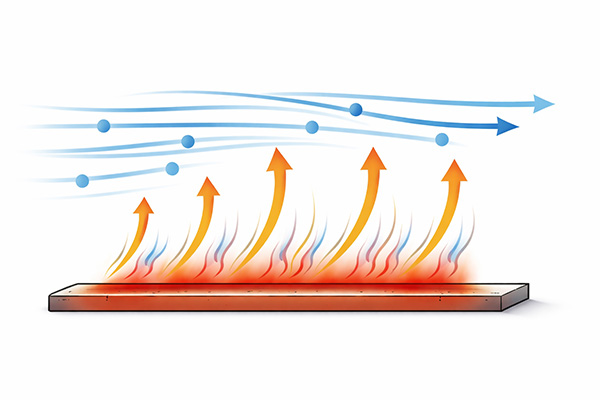
Calculate Nusselt number and convective heat transfer coefficient. Provided by CFD Vision.
About CFD Vision
For CFD consulting services, advanced heat transfer simulations, or customized engineering solutions, visit our main page.
This Nusselt Number Calculator is developed by CFD Vision to support engineers with practical, transparent, and reliable thermal analysis tools.
Related Links:
Multi-Layer Total Heat Transfer Coefficient Calculator for Convection and Conduction