
Our Pipe Flow Pressure Drop Calculator allows engineers, students, and industry professionals to accurately calculate pipe flow pressure drop for liquids in both laminar and turbulent flow regimes. The tool incorporates the Darcy-Weisbach equation and considers pipe roughness, diameter, length, and fluid properties. You can choose from a database of common liquids or enter custom fluid properties.
Quick answer
ΔP = f · (L/D) · (ρV²/2) (Darcy-Weisbach), where f is the Darcy friction factor, L and D are the pipe length and diameter, ρ is density and V is the mean velocity.
For laminar flow (Re < 2,300), f = 64/Re. For turbulent flow, this calculator uses the Haaland approximation of the Colebrook equation, which accounts for pipe roughness.
Why Use This Calculator?
- Saves time compared to manual calculations.
- Supports SI and Imperial units, dynamically converting values.
- Provides flow regime detection (laminar or turbulent) automatically.
- Includes database of common liquids (water at different temperatures, oil, glycerin, etc.).
- Allows input by velocity or volumetric flow rate.
- Pipe roughness can be chosen from common pipe materials.
- Editable fluid properties even when selected from the database.
Equations Used
1. Reynolds Number (Re):
Where:
- = fluid density
- = velocity (or calculated from flow rate)
- = pipe diameter
- = dynamic viscosity
2. Darcy-Weisbach Friction Factor (f):
- Laminar Flow (Re < 2300):
- Turbulent Flow (Re ≥ 2300):
Haaland approximation:
Where = pipe roughness
3. Pressure Drop (ΔP) – Darcy-Weisbach:
Where:
- = pipe length
- = pipe diameter
4. Velocity from Volumetric Flow Rate:
Where = volumetric flow rate, = pipe cross-sectional area
How to Use the Pipe Flow Pressure Drop Calculator
- Select your unit system (SI or Imperial).
- Choose a fluid from the database or input custom properties.
- Enter pipe parameters: diameter, length, roughness, flow rate or velocity.
- Select pipe flow type (auto-detect laminar/turbulent or manually).
- Click Calculate to view:
- Reynolds number
- Friction factor
- Pressure drop (ΔP)
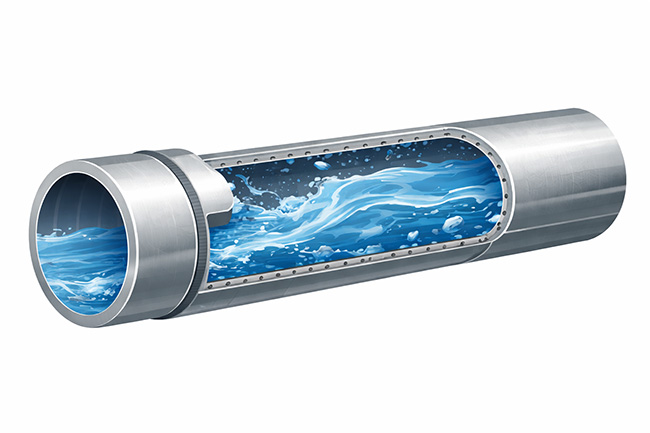
Pipe flow pressure drop calculator
Calculate pressure drop in pipes for laminar and turbulent flow using Darcy-Weisbach. Provided by CFD Vision.
kg/m³ Pa·s mm mm mPipe Pressure Drop FAQ
Can I use this calculator for gases?
This calculator is designed for liquid flows only. Gas properties vary significantly and require compressible flow analysis.
Can I edit the properties of fluids from the database?
Yes, once you select a fluid, all properties are editable.
Does the calculator automatically convert units?
Yes, all values are dynamically converted when switching between SI and Imperial units.
How is pipe roughness handled?
You can select common pipe materials (steel, PVC, copper, etc.), or manually enter roughness in mm.
Does the result include minor losses from fittings and valves?
No. The calculator gives the major (friction) loss of a straight pipe. Losses from bends, valves, tees and entrances are usually added separately with loss coefficients, ΔP = K·ρV²/2. Where fittings interact or the flow is strongly three-dimensional, a CFD analysis gives a more reliable estimate.
Related Engineering Calculators
Continue your analysis with the other free engineering calculators from CFD Vision:
Check whether a flow is laminar, transitional or turbulent for common gases, water or custom fluids.
Nusselt number and convective heat transfer coefficient from standard internal and external flow correlations.
Multi-Layer Heat Transfer Coefficient Calculator
Overall U-value and total thermal resistance for walls with conduction, contact resistance and convection.
CFD Y+ and First-Cell Height Calculator
Estimate the first-cell height for a target y+ before building inflation layers in your CFD mesh.
LMTD, effectiveness-NTU, heat duty, outlet temperatures, required area and pressure drop.
Flow Over a Cylinder Visualization
Interactive view of boundary-layer separation, wake formation and vortex shedding as Reynolds number changes.
Need More Than a Hand Calculation?
This Pipe Flow Pressure Drop Calculator is provided by CFD Vision as a professional tool for hydraulic analysis. For expert CFD consulting services, detailed simulations, or support with complex piping and flow projects, contact us.
For CFD consulting services in Australia , advanced heat transfer simulations, or customized engineering solutions, visit our main page or read About CFD Vision. For manifolds, valves and fittings, our CFD simulation and analysis services show where the pressure is actually lost.