
Choosing the time step is one of the first decisions in any transient CFD simulation, and one of the easiest to get wrong. Too large, and the solution becomes unstable or smears out the unsteady features you are trying to capture. Too small, and the run takes days longer than it needs to. The Courant number, also called the CFL number, links the time step to the mesh and the flow velocity and gives a reliable starting point.
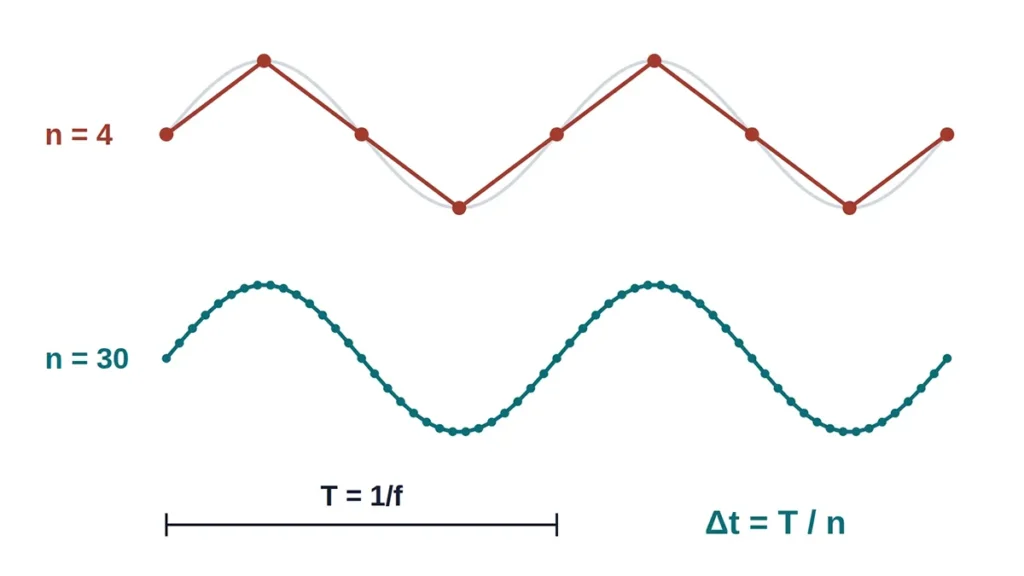
This free CFD time step calculator estimates Δt from a target Courant number, then checks it against optional limits that often matter more: the acoustic Courant number in compressible flow, the diffusion number for explicit schemes, and the number of time steps needed to resolve a known frequency such as vortex shedding. It also estimates the flow-through time, the number of time steps and the wall-clock time, so you can see what a run will cost before you launch it.
For a feel of the physics that a well-chosen time step must capture, the flow over a cylinder visualisation shows how vortex shedding develops as the Reynolds number changes.
Quick answer
A starting time step for transient CFD is Δt = C · Δx / U, where C is the target Courant number, Δx the smallest cell size in the region of interest and U the local flow velocity. For example, with U = 10 m/s, Δx = 0.5 mm and C = 1, Δt = 50 µs.
Treat this as a first estimate based on one representative velocity and cell size. Your solver calculates a local Courant number in every cell from the face fluxes, cell geometry and its own definition, so the maximum it reports can be noticeably higher, especially in small, stretched or skewed cells. The final time step also depends on the solver, the discretisation, the physics and the temporal resolution you need, so confirm it with a time-step sensitivity study.
CFD Time Step Calculator (Courant / CFL Number)
Estimate a starting time step for a transient CFD simulation from the convective Courant number, then check it against optional acoustic, diffusion and temporal-resolution limits. The calculator also estimates the number of time steps, simulated time and run time.
1. Flow and Mesh
2. Additional Limits (optional)
3. Run Length and Cost (optional)
Time Step Results
| Constraint | Formula | Δt limit | Value at recommended Δt | Value at rounded Δt |
|---|