
CFD Analysis Services
Thermal & Fluid Flow CFD Analysis & Modeling Services for Industry and Research
Engineering systems involving fluid flow, heat transfer, ventilation, pressure, aerodynamics, rotating equipment, or multiphase behavior can be difficult to evaluate using conventional calculations alone.
CFD Vision provides thermal and fluid flow CFD analysis and modeling—covering airflow and ventilation, heat transfer, pressure losses, rotating equipment, and multiphase flow—to help engineering companies and research teams understand system behavior, identify design problems, compare alternatives, and make better-informed decisions. Each project is delivered as part of our computational fluid dynamics consulting and led by a PhD-qualified CFD consultant.
From initial model preparation to final engineering recommendations, we build each simulation around the specific objectives of your project. The goal is not simply to generate CFD results—it is to provide engineering insight that supports better performance, lower design risk, and more efficient development.
On this page: What thermal & flow CFD analysis delivers · Benefits · Industries · Process · Inputs & deliverables · Technical quality · FAQ
What Does Thermal and Fluid Flow CFD Analysis Deliver?
Thermal and fluid flow CFD analysis uses computational fluid dynamics—numerical modeling of fluid flow, heat transfer, and related physics—to answer specific design or performance questions. Rather than simply supplying software output, a proper CFD analysis defines the problem, builds and checks the model, and turns flow and thermal results into engineering recommendations.
CFD is most useful when flow or thermal behavior is three-dimensional, coupled, or difficult to measure; when several design options must be compared before prototyping; or when an existing system underperforms and the cause is unclear.

Dr Ryan Mozafari
Founder of CFD Vision. PhD in thermal-fluid science (Macquarie University) with 10+ years applying CFD to industrial and academic problems. Based in Sydney, NSW.
CFD Analysis That Supports Better Engineering Decisions
Our CFD analysis services support projects at different stages, from early design and concept evaluation to troubleshooting and optimization of existing systems. Depending on the project, CFD modeling can help companies:
01
Improve Performance
Evaluate airflow, fluid distribution, pressure losses, heat transfer, cooling effectiveness, aerodynamic behavior, and other important performance characteristics.
02
Identify Problems Earlier
Detect recirculation, hot spots, excessive pressure losses, poor ventilation, flow separation, and uneven distribution before expensive modifications are made.
03
Compare Design Alternatives
Evaluate different geometries, operating conditions, equipment arrangements, or design concepts using consistent engineering criteria.
04
Reduce Development Risk
Use simulation to support engineering decisions before committing to prototypes, manufacturing changes, or full-scale testing.
05
Support Product and System Optimization
Identify where changes may improve efficiency, thermal performance, flow behavior, reliability, or overall system operation.
Need more than simulation? CFD can be integrated into broader design development.
Thermal and Fluid Flow CFD Modeling Across Industries and Applications
Our CFD simulation services cover a wide range of engineering, industrial, and research applications. The modeling approach is selected according to the physical behavior, operating conditions, and engineering objectives of each project.
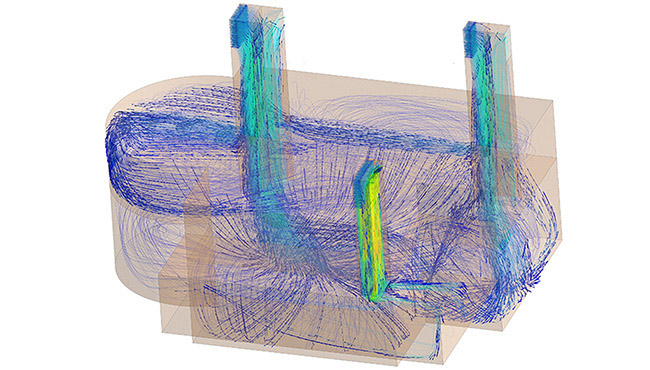
HVAC, Building & Data Centre CFD
CFD simulation can help evaluate airflow, temperature distribution, ventilation effectiveness, thermal comfort, smoke movement, and air distribution within buildings and HVAC systems.
Typical applications: offices, industrial buildings, data centers, ventilation systems, ducts, indoor environments, and naturally or mechanically ventilated spaces.
Read more: CFD for building ventilation · data center cooling
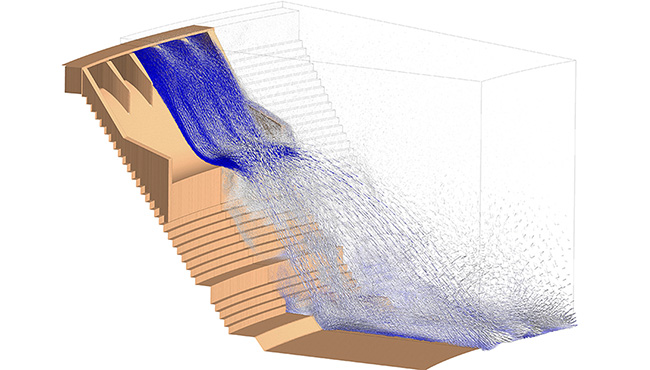
Hydraulic & Water Systems
We use computational fluid dynamics analysis to investigate water flow through pipelines, tanks, channels, hydraulic structures, weirs, outlets, and other water systems—providing insight into pressure losses, velocity distribution, free-surface behavior, hydraulic jumps, recirculation, and flow distribution.
Typical applications: pipelines, tanks, open channels, weirs, outlets, and hydraulic structures.
Related: dam reservoir circulation project · pipe pressure drop calculator
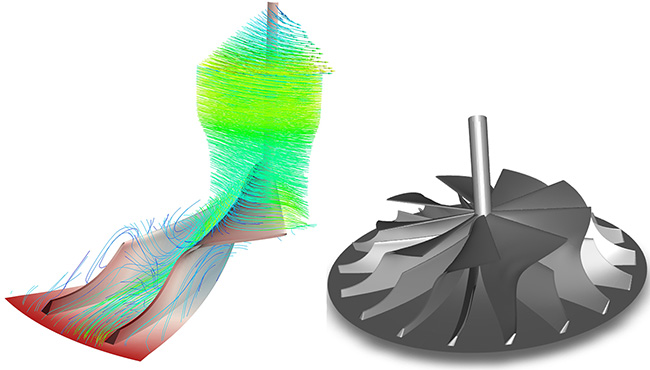
Turbomachinery & Rotating Equipment
CFD simulation can evaluate the complex flow behavior inside rotating equipment, supporting performance evaluation, pressure and velocity assessment, identification of flow losses, and comparison of different operating conditions or designs.
Typical applications: pumps, fans, compressors, turbines, and impellers.
Related: centrifugal pump performance · slurry pump cavitation · compressor blade optimization
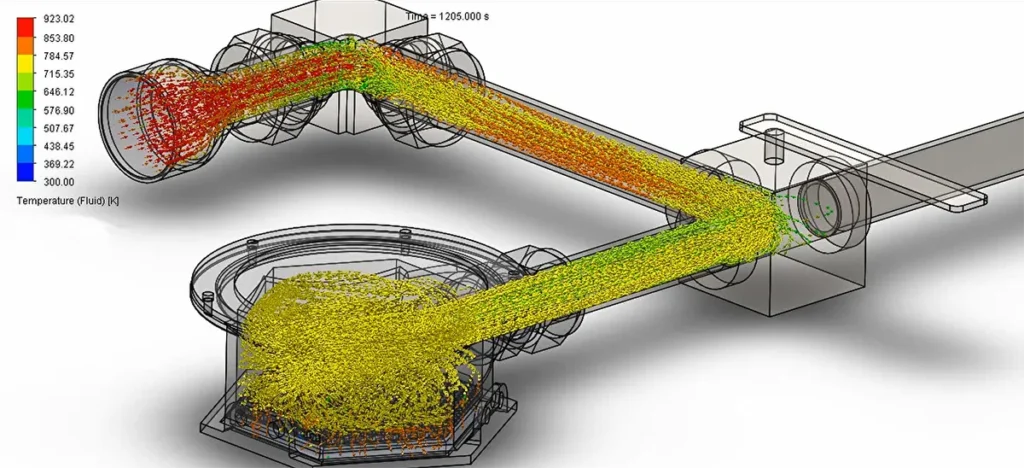
Thermal & Heat Transfer Simulation
Thermal CFD analysis helps engineers understand how fluid flow and heat transfer interact within equipment and products.
Typical applications: heat exchangers, electronics cooling, battery thermal management, heat sinks, cooling channels, HVAC equipment, and industrial heating or cooling systems.
Related: CPU heatsink cooling project · CFD thermal management · heat exchanger calculator
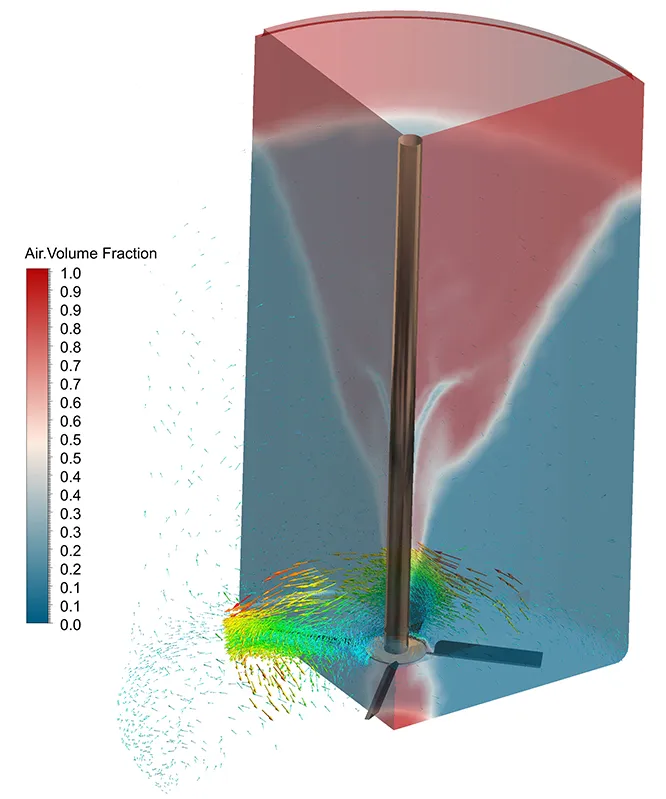
Multiphase & Process Flow
Many industrial processes involve liquids, gases, particles, free surfaces, droplets, bubbles, or interactions between multiple phases. Our CFD modeling services support these complex multiphase applications.
Typical applications: filling processes, mixing systems, tanks, porous media, process equipment, free-surface flows, and liquid–gas systems.
Related: hydrocyclone particle filtration · microdroplet impact (VOF)
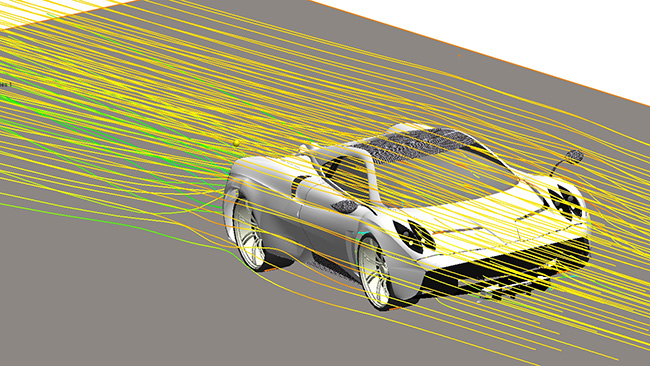
Aerodynamics & External Flow
External-flow CFD evaluates how air interacts with vehicles, buildings, products, structures, and other exposed geometries—including aerodynamic drag, lift, pressure distribution, wake behavior, flow separation, and wind effects.
Typical applications: vehicles, buildings, products, structures, and evaluation of geometry modifications.
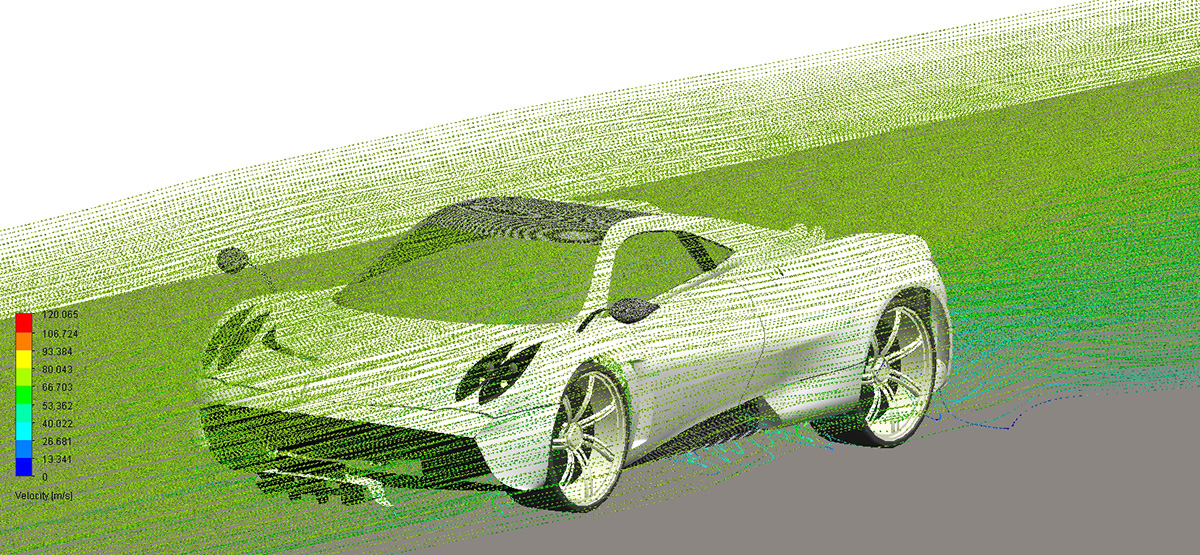
Related: sports car aerodynamics · airfoil stall at Mach 0.6 · aerodynamic optimization with CFD
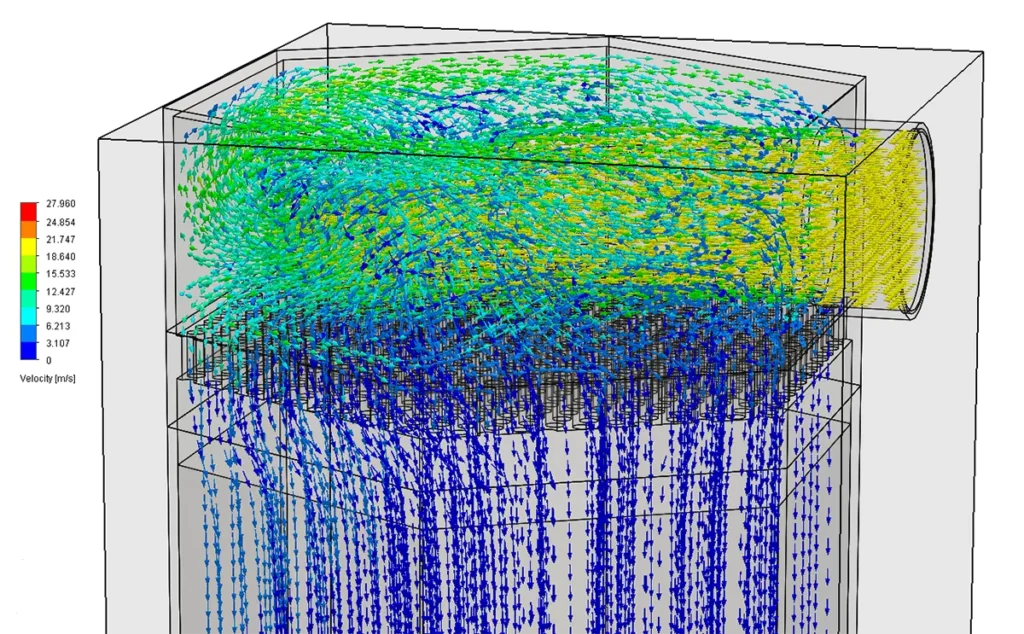
Industrial Fluid Flow & Equipment
CFD provides detailed fluid flow analysis inside industrial equipment where simplified calculations may not capture important three-dimensional effects.
Typical applications: pipelines, manifolds, valves, ducts, nozzles, diffusers, tanks, separators, and flow distribution systems.
Related: oil-lubricated bearing project · Reynolds number calculator
Research, Technology & Advanced CFD
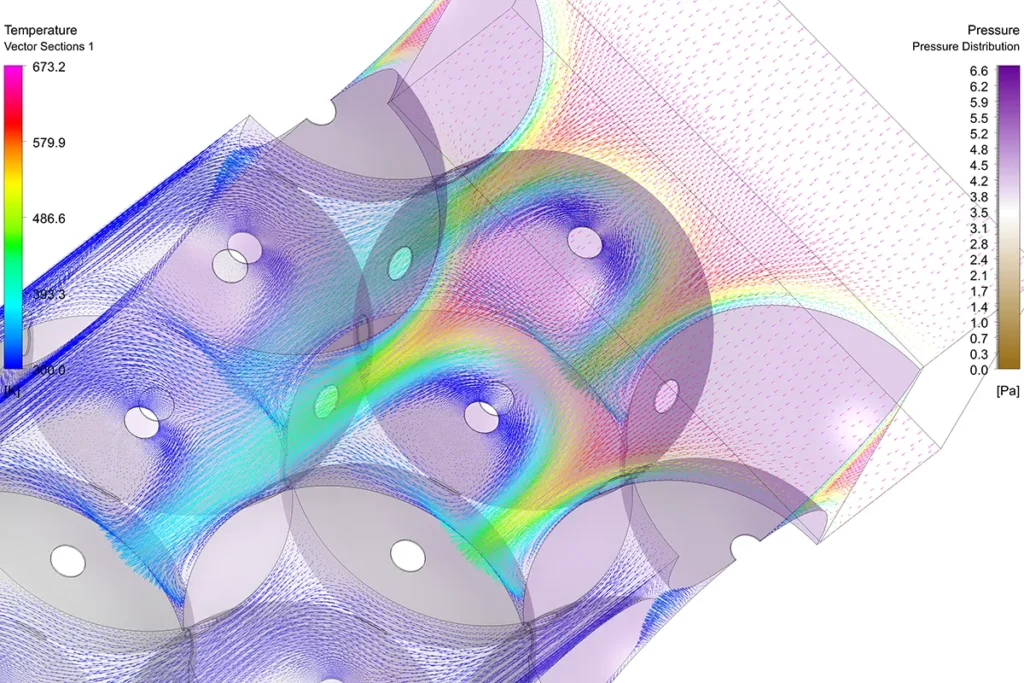
CFD Vision also supports engineering and research projects involving unconventional geometries, new technologies, advanced physical phenomena, experimental development, and specialized numerical analysis—with additional attention to validation, sensitivity studies, numerical methodology, and technical documentation where appropriate.
Related: microdroplet boiling and freezing · microchannel combustion · human upper airway flow
Building in-house capability? Explore our CFD Training and ANSYS Fluent Support.
How a CFD Analysis Project Works
A professional CFD project should begin with the engineering problem—not with the simulation software. A typical thermal or fluid flow CFD analysis project includes four main stages.
01
Understand the Engineering Challenge
We review the project objectives, available geometry, operating conditions, existing data, and the engineering questions that need to be answered. This defines an appropriate simulation scope and the outputs that will be genuinely useful.
02
Develop the CFD Model
The geometry is prepared, physical models and boundary conditions are selected, and a computational mesh is developed for the problem. Numerical complexity follows the engineering objective rather than a one-size-fits-all approach. See our guides to turbulence models and first-cell height (y+).
03
Analyze and Evaluate the Results
Results are examined using relevant engineering quantities—velocity, pressure, temperature, heat transfer, forces, flow distribution, or project-specific parameters. Different operating conditions or design alternatives can be compared where necessary.
04
Provide Engineering Conclusions
Simulation results become information that supports engineering decisions: important findings explained, performance limitations identified, alternatives compared, and opportunities for design or system improvement highlighted.
What Information Do We Need From You?
The exact requirements depend on the project. Useful information commonly includes:
- CAD geometry or engineering drawings
- Flow rates, velocities, or pressures
- Operating temperatures
- Fluid and material information
- Thermal loads
- Rotational speeds or equipment operating conditions
- Existing experimental or performance data
- The main engineering problem you want to investigate
You do not need a complete CFD specification before contacting us. If some information is unavailable, we can review the project and identify which inputs are essential and which assumptions may reasonably be made.
What Do You Receive From a CFD Project?
Deliverables are defined by the scope of each project and may include:
- Engineering CFD results
- Velocity, pressure, and temperature distributions
- Flow streamlines and vector fields
- Thermal and heat-transfer results
- Pressure-drop and performance information
- Design comparisons
- CFD contours and technical plots
- Simulation animations
- Engineering interpretation and recommendations
- Technical reports where required
The emphasis is on results that are understandable and useful for engineering decisions—not raw simulation data.
Technical Quality Behind Our CFD Analysis
Reliable CFD analysis depends on more than generating visually attractive contours. The level of verification and validation is selected according to the objectives and technical requirements of each project.
More advanced projects may involve turbulent flow, multiphase modeling, conjugate heat transfer, rotating regions, transient simulation, or other specialized physical models.
Read: How to know if your CFD results are reliable →
What our simulation methodology considers
- Geometry preparation
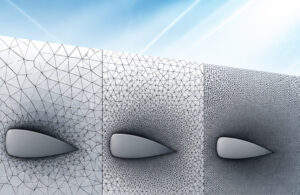
- Computational meshing
- Appropriate boundary conditions
- Physical model selection
- Convergence
- Mesh sensitivity
- Conservation of mass and energy
- Comparison with available experimental or reference data
CFD for Design Development and Optimization
CFD is particularly valuable when several designs or operating conditions need to be compared before physical changes are made. Simulation helps engineers answer questions such as:
Which design produces lower pressure loss?
Where are thermal hot spots developing?
Which configuration provides better cooling?
Which geometry provides better aerodynamic performance?
How can airflow distribution be improved?
How will changing operating conditions affect the system?
For projects that extend beyond simulation into broader design improvement, learn more about our Product Development and simulation-driven design services, or read how CFD fits into product development.
Thermal & Fluid Flow CFD Analysis FAQ
Common questions before starting a CFD analysis or modeling project.
When is CFD better than conventional engineering calculations?
When the flow or heat transfer is three-dimensional, turbulent, multiphase, or strongly coupled—for example recirculation in ducts, hot spots in electronics, or free-surface flow in hydraulic structures. Hand calculations give averages; CFD shows where and why performance changes.
Can CFD replace physical testing?
Not entirely. CFD reduces the number of prototypes and tests by screening design options virtually. Where results drive critical decisions, they should be validated against experimental or reference data.
Do I need a complete CFD specification before contacting you?
No. Share what you have—geometry, operating conditions, and the question you need answered. We will identify which inputs are essential and which assumptions are reasonable.
How long does a CFD analysis take, and how is it priced?
It depends mainly on geometry complexity, the physics involved (for example steady or transient flow, rotating parts, multiphase or conjugate heat transfer), and how many design cases need to be compared. After reviewing your geometry and objectives, we define the scope, timeline, and cost before any simulation work begins.
Which industries and applications do you support?
HVAC and building services, hydraulic and water systems, turbomachinery and rotating equipment, thermal and heat transfer systems, multiphase and process flow, aerodynamics and external flow, industrial equipment, and research or advanced CFD projects.
Do you provide data centre CFD analysis?
Yes. Data centre CFD analysis evaluates rack inlet temperatures, hot and cold aisle arrangements, cooling unit placement, airflow bypass and recirculation, so cooling problems can be found and fixed before they affect equipment. Read more about CFD for data centre cooling.
How do you make sure CFD results are reliable?
Through careful geometry preparation, meshing, boundary conditions, and physical model selection, supported by convergence and mesh-sensitivity checks, conservation of mass and energy, and comparison with experimental or reference data where available.
What will I receive at the end of a CFD project?
Engineering results such as contours, plots, animations, and design comparisons—together with interpretation and recommendations, and a technical report where required.
Work With CFD Vision
Every CFD project begins with a different engineering challenge. Whether you need to investigate an existing problem, compare design alternatives, improve system performance, or evaluate a new engineering concept, we can help determine an appropriate simulation approach.
Already have a project in mind? Send us the available geometry, operating information, and a short description of what you need to determine. Learn more about our engineering background on the About CFD Vision page.