
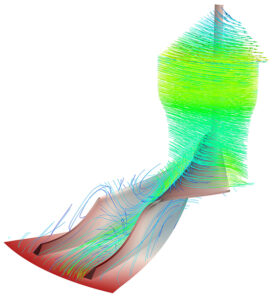
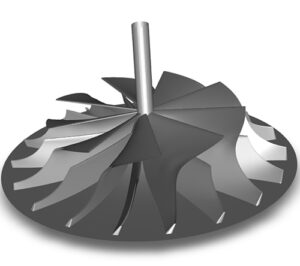
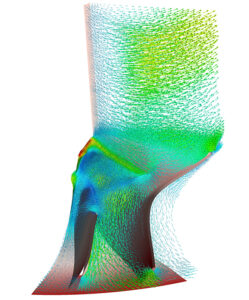
Aerodynamic study of a turbocharger-type centrifugal compressor impeller, comparing back-swept blade designs to improve pressure ratio and flow performance.
Sector
Automotive powertrain and turbocharging
Client
Turbomachinery R&D team
Flow type
Compressible, rotating, transonic
Project Snapshot
Challenge
Back-sweep angle trades pressure ratio against efficiency and stable operating range. High relative Mach numbers near the inducer tip can create shocks that limit efficiency, so the blade shape has to balance work input against loss.
Approach
A 3D blade-passage model with ideal-gas air in a rotating frame. Several back-sweep configurations were compared at matched operating conditions using pressure ratio, flow capacity and relative Mach number.
Key Findings
- A moderate back-sweep gave a better balance of pressure ratio and flow capacity than the extreme configurations.
- The highest relative Mach numbers occurred near the inducer tip, where shock formation drives total-pressure loss.
- Back-sweep also changed flow uniformity at the impeller exit, which affects diffuser performance downstream.
Deliverables
A performance comparison of blade designs, Mach number and pressure maps, and a recommended back-sweep direction for further product development.
Working on a similar problem?
Explore our CFD consulting services or send us your compressor or turbomachinery question. Learn more about our computational fluid dynamics consulting in Australia.