
These free engineering calculators cover the quick checks that come before, during and after a CFD simulation: flow regime, pressure loss, convective heat transfer, layered-wall U-values, heat exchanger sizing and near-wall mesh resolution. Each tool runs in your browser and is built on standard thermal-fluid correlations, the same hand calculations we use to set up and sanity-check our own CFD consulting projects.
Quick overview
7 free tools in 3 groups: heat transfer (multi-layer U-value, Nusselt number, heat exchanger), fluid flow (Reynolds number, pipe pressure drop, flow over a cylinder) and CFD setup (y+ first-cell height).
Jump to: Heat transfer · Fluid flow · CFD setup · Which one do I need?
Heat Transfer Calculators
Estimate conduction and convection resistances, heat transfer coefficients and exchanger performance before committing to a detailed thermal model.
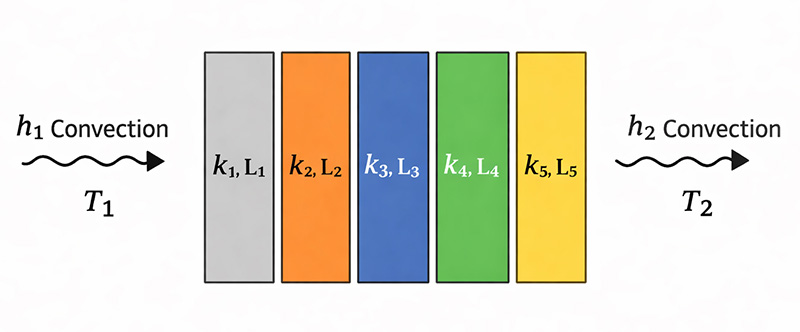
Multi-Layer Heat Transfer Coefficient Calculator
Overall heat transfer coefficient (U) and total thermal resistance for up to five solid layers in series, with contact resistance and optional convection. Metric or British units.
Best for: insulated walls, composite panels, enclosures and pipe lagging.
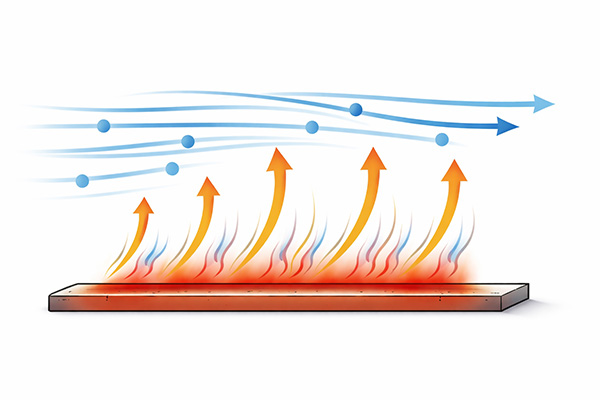
Nusselt Number Calculator
Nusselt number and convective heat transfer coefficient h for internal pipe and channel flow or external flat-plate flow, using standard correlations such as Dittus–Boelter, with automatic laminar/turbulent detection.
Best for: convection boundary conditions and checking CFD wall heat flux.
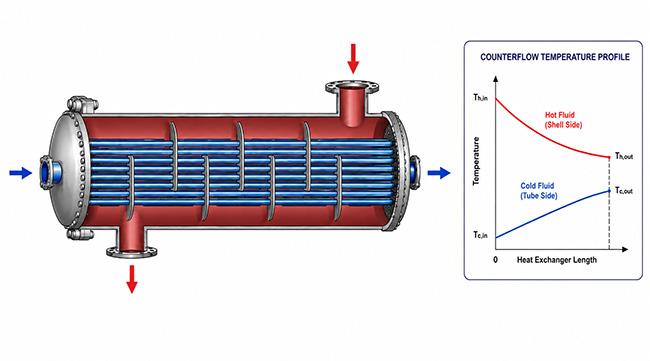
Heat Exchanger Calculator
Performance mode (effectiveness–NTU) or sizing mode (LMTD) for counterflow and parallel-flow exchangers: heat duty, effectiveness, outlet temperatures and required area, plus optional pressure drop and pumping power.
Best for: first-pass exchanger sizing and rating an existing unit.
Fluid Flow Calculators and Visualization
Identify the flow regime, estimate pipe losses and see how separation and vortex shedding develop as Reynolds number increases.
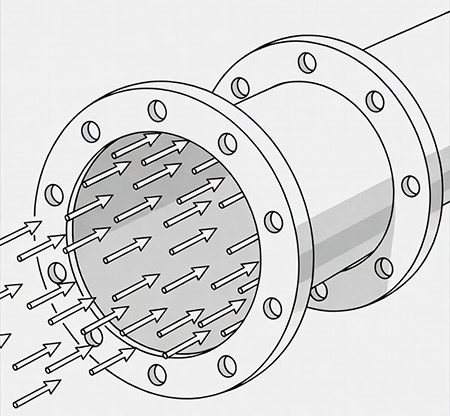
Reynolds Number Calculator
Reynolds number and flow regime for water, air, common gases or a custom fluid, using either dynamic or kinematic viscosity.
Best for: deciding between a laminar and a turbulence model in CFD.
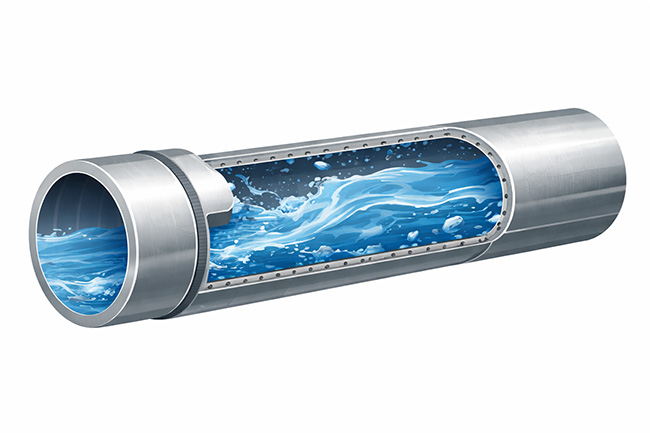
Pipe Flow Pressure Drop Calculator
Darcy–Weisbach pressure drop, friction factor (Haaland) and flow regime for a straight pipe, in SI or Imperial units. Minor losses from fittings and valves are not included.
Best for: pipeline sizing, pump duty estimates and checking CFD pressure loss.
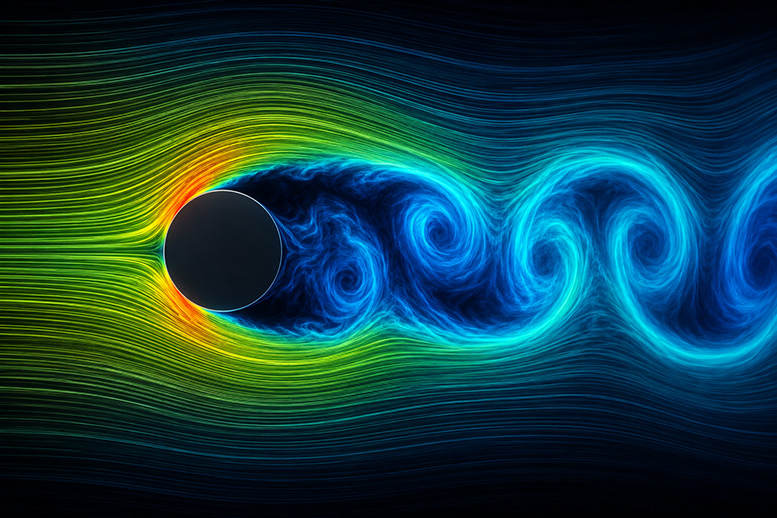
Flow Over a Cylinder Visualization
Move a slider from creeping flow (Re ≈ 1) to the drag crisis (Re ≈ 3 × 10⁵) and watch separation, wake formation and vortex shedding change, with drag trends from classical correlations.
Best for: teaching, and building intuition for bluff-body flows.
CFD Setup Tools
Near-wall mesh resolution is one of the most common reasons a CFD model gives the wrong wall shear stress, pressure drop or heat transfer. Size the first cell before you mesh, not after.
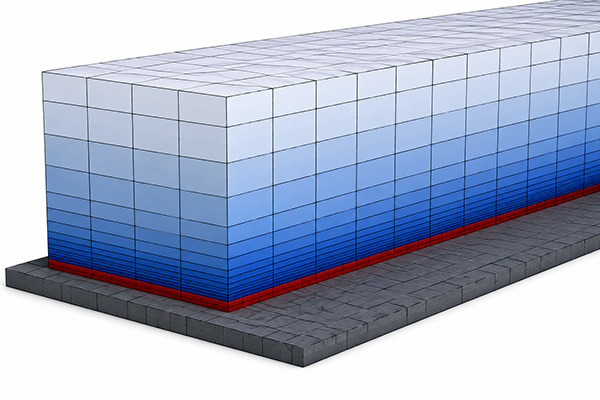
CFD Y+ and First-Cell Height Calculator
First-cell height for a target y+ from velocity, reference length and fluid properties, using a flat-plate skin-friction estimate.
Rule of thumb: target y+
- y+ ≈ 1 for wall-resolved turbulence models such as SST k-ω, when wall shear stress, separation or heat transfer matter.
- y+ above about 30 when using wall functions, typically for large industrial models where near-wall detail is less critical.
- Avoid placing the first cell in the buffer layer (roughly 5 < y+ < 30) unless your solver’s wall treatment is designed for it.
The calculator gives a starting value. Always check the actual y+ distribution after the first solution, because local velocity and wall shear vary across the model. Our article on turbulence models in Ansys Fluent explains how this choice links to the model you select.
Which Calculator Do You Need?
| Your question | Use this tool |
|---|---|
| Is my flow laminar, transitional or turbulent? | Reynolds Number Calculator |
| How much pressure will I lose along a straight pipe? | Pipe Flow Pressure Drop Calculator |
| What convective heat transfer coefficient (h) should I use? | Nusselt Number Calculator |
| What is the overall U-value of a layered wall or panel? | Multi-Layer Heat Transfer Coefficient Calculator |
| What heat duty, outlet temperature or area will my heat exchanger have? | Heat Exchanger Calculator |
| How thick should the first inflation layer in my CFD mesh be? | CFD Y+ and First-Cell Height Calculator |
| How do separation and vortex shedding change with Reynolds number? | Flow Over a Cylinder Visualization |
When a Hand Calculation Is Not Enough
Correlations assume idealized geometry: a straight pipe, a flat plate, fully developed flow. Real equipment has bends, manifolds, fins, recirculation, conjugate heat transfer and multiphase effects. When those details drive performance, a hand calculation gives a starting estimate, and CFD gives the answer.
01 · Consulting
CFD Consulting & Simulation
Full 3D CFD analysis of flow, heat transfer and pressure loss for industrial equipment and systems.
02 · Design
Product Development
Simulation-driven design to compare concepts and improve performance before you build a prototype.
03 · Training
CFD & Ansys Fluent Training
Practical Ansys Fluent training and academic CFD support for students, researchers and engineering teams.
04 · Case studies
CFD Simulation Projects
Pumps, heat sinks, hydrocyclones, external aerodynamics, combustion and multiphase flow projects.
Engineering Calculators FAQ
Are these engineering calculators free?
Yes. All tools on this page are free to use and run directly in your browser.
How accurate are the results?
The calculators use established correlations such as Darcy–Weisbach with the Haaland friction factor, Dittus–Boelter, LMTD and effectiveness–NTU. They are as accurate as those correlations within their valid range, which is suitable for preliminary design and cross-checking, but not a replacement for detailed simulation or testing of complex geometry.
How do these tools help with a CFD simulation?
Use the Reynolds number to choose between a laminar and a turbulence model, the y+ calculator to size the first mesh cell, and the Nusselt, pressure drop and heat exchanger calculators to set boundary conditions and check that CFD results are in the right range. For more on checking results, see our guide to CFD validation.
When should I use CFD instead of a calculator?
Use CFD when the geometry is three-dimensional or irregular, the flow separates or recirculates, heat transfer couples solids and fluids, or several phases interact. In these cases single-value correlations can miss local hot spots, losses and flow maldistribution.
Have a Problem the Calculators Cannot Solve?
Send us your geometry, operating conditions and the question you need answered. We will tell you whether a hand calculation is enough or whether a CFD simulation is worth running.