
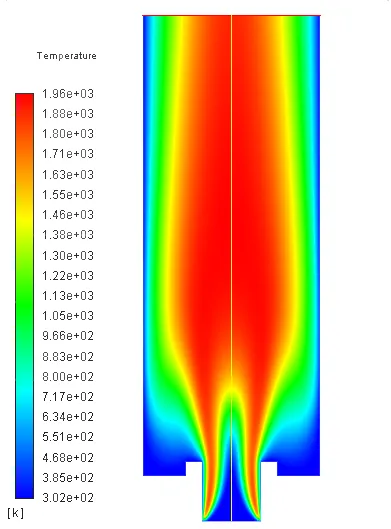
Predicted temperature distribution and flame position inside the microchannel
Research CFD study of combustion inside a microchannel, where flow, chemistry and wall heat transfer are tightly coupled and flame stability is hard to maintain.
Sector
Energy research
Client
University research group
Flow type
Reacting, laminar, conjugate heat transfer
Project Snapshot
Challenge
At microscale, the walls absorb a large share of the heat released, which can quench the flame. Keeping combustion stable in such small channels is the central challenge for micro-power and micro-reactor concepts.
Approach
A reacting-flow simulation with species transport and chemical kinetics, coupled to heat conduction in the channel walls, across a range of inlet velocities and wall thermal conditions.
Key Findings
- Wall heat loss controlled whether the flame stabilized or quenched.
- Heat conducted upstream through the walls preheated the incoming mixture, which helped flame stability.
- The flame position shifted with inlet velocity, defining a stable operating window.
Deliverables
Temperature, velocity and species fields, flame-stability insights and results suitable for research publications on microscale combustion.
Working on a similar problem?
Explore our CFD consulting services or send us your combustion or reacting-flow question. Learn more about our computational fluid dynamics consulting in Australia.