
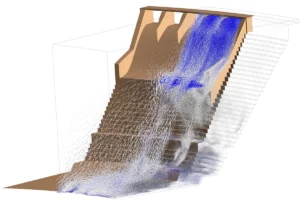
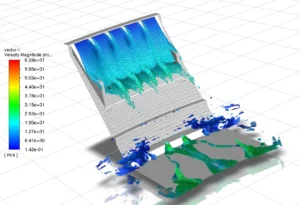
A 3D CFD model of the Ghadrooni Dam reservoir, used to predict water circulation and show how wind over the surface changes the flow inside the reservoir.
Sector
Water resources
Client
Water authority / hydraulic engineering consultancy
Flow type
Free-surface, wind-driven, turbulent
Project Snapshot
Challenge
Reservoir circulation is often assumed to be driven only by inflows and outflows. Wind over a large water surface can change mixing and stagnant regions, but it is rarely included in hydraulic assessments.
Approach
A 3D reservoir model using the Volume of Fluid (VOF) method for the air–water interface and the k-ω SST turbulence model, comparing conditions with and without wind-driven airflow.
Key Findings
- Surface wind significantly changed the direction and strength of recirculation zones.
- Wind-driven circulation reached well below the surface, affecting mixing across the reservoir.
- Stagnant regions shifted with wind conditions, which matters for water quality and sediment transport.
Deliverables
Circulation and velocity maps, identified stagnant and mixing zones, and insight for reservoir operation and environmental assessment.
Working on a similar problem?
Explore our CFD consulting services or send us your dam, reservoir or water-system question. If you need this kind of analysis for a real design, our Sydney-based CFD consulting team supports engineering firms and manufacturers across Australia, from scoping to final report.