
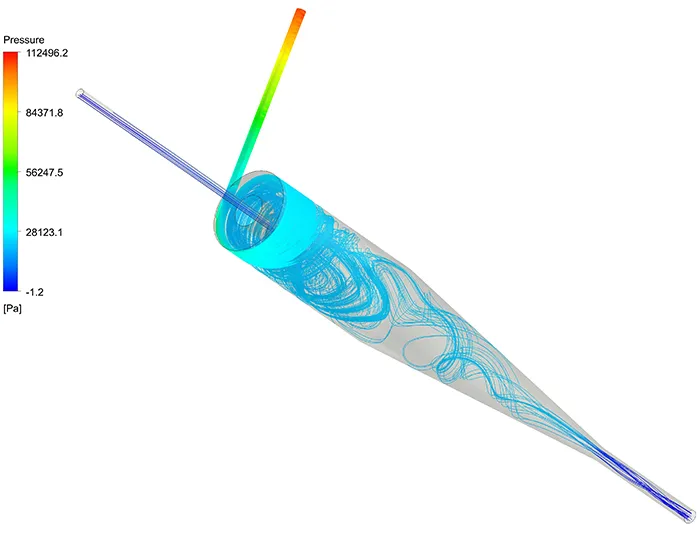
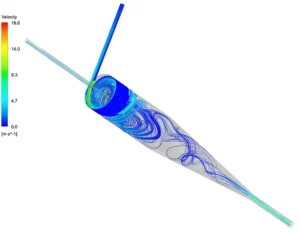
This project investigated the separation performance of a hydrocyclone used for fine-particle filtration from a contaminated liquid stream. The fluid enters the hydrocyclone tangentially, generating a strong swirling flow that produces centrifugal forces and drives denser particles toward the outer wall, while the cleaner fluid moves toward the central region and exits through the overflow.
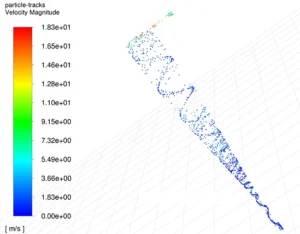
A CFD simulation was performed using an Eulerian–Lagrangian approach with a Discrete Phase Model (DPM) to predict the trajectories and separation behavior of suspended particles within the hydrocyclone. The analysis provided insight into the internal vortex structure, particle paths, pressure distribution, and regions influencing separation efficiency.
Because hydrocyclone performance is highly sensitive to geometry, CFD can be particularly useful during product development and design optimization, allowing different inlet, cone, vortex-finder, and outlet configurations to be evaluated before physical prototypes are manufactured. This approach can help improve filtration efficiency, reduce design iterations, and support more reliable particle-separation systems for water treatment and industrial process applications.
Contact CFD Vision to discuss hydrocyclone CFD, particle-separation simulation, or multiphase-flow analysis.