
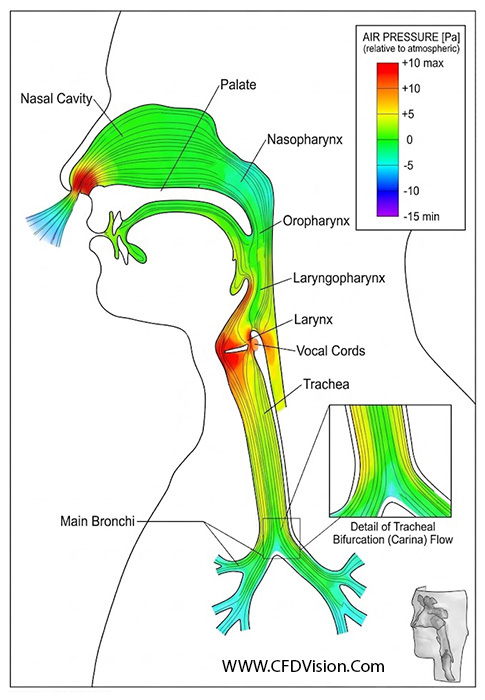
Velocity distribution through the upper airway during inhalation
Research-focused CFD study of inhalation airflow through the human upper airways, showing where the flow accelerates, separates and loses pressure inside a complex anatomical geometry.
Sector
Biomedical research
Client
University research group
Flow type
Internal, anatomical, transitional
Project Snapshot
Challenge
The upper airway has a complex geometry with sudden contractions and bends. Local jets and recirculation affect breathing resistance and particle deposition, but they are very hard to measure inside the body.
Approach
A 3D model based on anatomical airway geometry, inhalation boundary conditions and a turbulence model able to handle transitional flow, with refined mesh at the narrowest sections.
Key Findings
- Flow accelerated sharply through the narrowest passages, forming jet-like regions with high wall shear.
- Recirculation zones formed downstream of constrictions, where inhaled particles and aerosols are likely to deposit.
- Most of the pressure drop occurred in a few short sections, showing where geometry controls breathing resistance.
Deliverables
Velocity, pressure and wall-shear maps and flow visualizations suitable for research publications and further respiratory or medical-device studies.
Working on a similar problem?
Explore our CFD consulting services or send us your biomedical or research CFD question.