
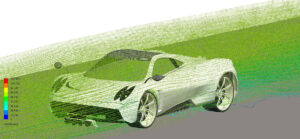
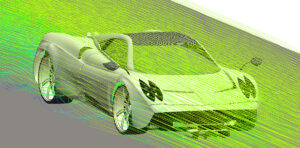
External aerodynamics CFD of a high-performance sports car, mapping flow over, under and behind the body to identify where drag and lift are generated and which details offer the greatest aerodynamic gains.
Sector
Automotive
Client
University research group
Flow type
External, turbulent, 3D
Project Snapshot
Challenge
A sports car must combine low drag with enough downforce, balanced between the front and rear axles, to stay stable at speed. Small details such as the front splitter, mirrors, wheel arches, underbody and rear deck decide where the flow separates, how large the wake becomes and how lift is distributed front to rear.
Approach
The full vehicle was simulated in a virtual wind tunnel with a moving ground and rotating wheels, so underbody and wheel flows were represented realistically. The mesh was refined around the body, wheels and wake, and a turbulence model suited to separated external flow was used. Drag, lift and the front and rear load split were evaluated alongside the surface pressure and wake structure.
Key Findings
- The rear separation region and wake produced the largest share of pressure drag, making the rear deck and diffuser geometry the main levers for drag reduction.
- High pressure at the nose and suction over the roof and rear screen set the lift balance, with a tendency toward rear lift that affects high-speed stability.
- Rotating wheels and wheel-arch flow injected turbulent, low-energy air into the underbody and wake, reducing diffuser effectiveness and adding drag.
- Mirror and A-pillar wakes were local but measurable drag contributors, and low-cost targets for refinement.
Deliverables
Pressure and velocity fields, drag and lift assessment with the front and rear balance, wake and underbody flow visualisation, and a ranked list of geometry regions with the most potential for improvement. Read more about aerodynamic performance analysis with CFD simulation.
Working on a similar problem?
Explore our CFD consulting services or send us your vehicle aerodynamics question. Learn more about our computational fluid dynamics consulting in Australia.