
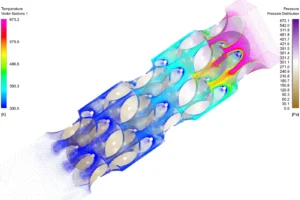
Pore-scale CFD simulation resolved flow and heat transfer between individual particles in a packed-bed thermal energy store, revealing the local mechanisms that control pressure drop, thermal front sharpness and charging efficiency.
Sector
Thermal energy storage research
Client
Energy storage research center
Flow type
Pore-scale turbulent flow and conjugate heat transfer
Project Snapshot
Challenge
Packed-bed storage performance depends on how well the heat-transfer fluid contacts the solid particles. Conventional porous-media models average out local effects such as wall channelling, stagnant zones and uneven particle heating, even though these effects broaden the thermal front and reduce usable storage capacity.
Approach
A realistic particle packing was generated and meshed at pore scale, resolving the fluid passages between particles and heat conduction within them. Transient charging was simulated to track the thermal front, pressure drop and particle-to-fluid heat transfer through the bed.
Key Findings
- Higher porosity near the container wall caused flow channelling, so the thermal front advanced faster along the wall than in the core of the bed.
- Low-velocity regions behind particle contact points heated more slowly, which broadened the thermal front and reduced the effective storage capacity.
- The pore-scale results provided pressure-drop and heat transfer data for calibrating faster system-level porous-media models used in storage design.
Deliverables
Pore-scale velocity and temperature fields, thermal-front evolution, pressure-drop and heat transfer data, and design insight for packed-bed thermal energy storage.
Working on a similar problem?
Explore our CFD consulting services and engineering simulation services, or send us your packed-bed thermal energy storage question.