
From Flow Visualization to CFD Simulation
This interactive tool a simplified way to visualize the fundamental physics of external flow around a cylinder. The same principles, including boundary layer development, flow separation, wake formation, pressure variation, and vortex shedding, are important in more advanced external flow simulations.
For a broader understanding of how computational fluid dynamics can be applied to real engineering problems, explore our aerodynamics and CFD simulation content, where external flows around engineering components and systems are considered in greater detail.
Applications in Aerodynamics and External Flow
Flow around a cylinder is a fundamental example of external aerodynamics. Understanding how Reynolds number affects separation and wake behaviour provides a useful foundation for analysing more complex geometries such as vehicles, aerodynamic components, structures, and other bodies exposed to fluid flow.
In practical engineering applications, CFD Consulting can be used to investigate quantities such as pressure distribution, aerodynamic forces, drag, lift, flow separation, turbulence, and wake behaviour. These applications typically require a complete numerical model with appropriate geometry, mesh, boundary conditions, fluid properties, and turbulence modelling.
If you are interested in applying these techniques to a specific engineering problem, you can learn more about our CFD consulting services and the range of CFD simulation services available through CFD Vision.
Explore More CFD Topics
The cylinder-flow example provides a useful introduction to several fundamental concepts in computational fluid dynamics. Continue exploring CFD Vision for additional content covering HVAC and Data Centers, Product Development, and engineering simulation.
For practical engineering analysis, the simplified visualization presented here should be treated as an educational tool rather than a replacement for a validated CFD study. Detailed engineering simulations require appropriate model selection, mesh verification, numerical validation, and comparison with analytical or experimental data where appropriate.
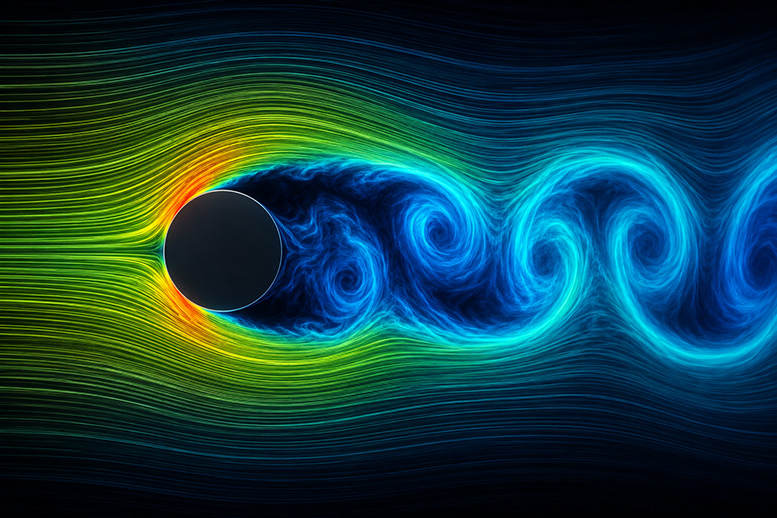
Note: This visualization uses a simplified mathematical representation and classical correlations for flow around a cylinder. It does not perform a full numerical CFD solution and should not be interpreted as a validated engineering simulation.
Boundary Layer Separation Around a Cylinder
Drag the Reynolds number and watch where the boundary layer detaches from the surface, how the wake widens, and where drag crisis kicks in.