
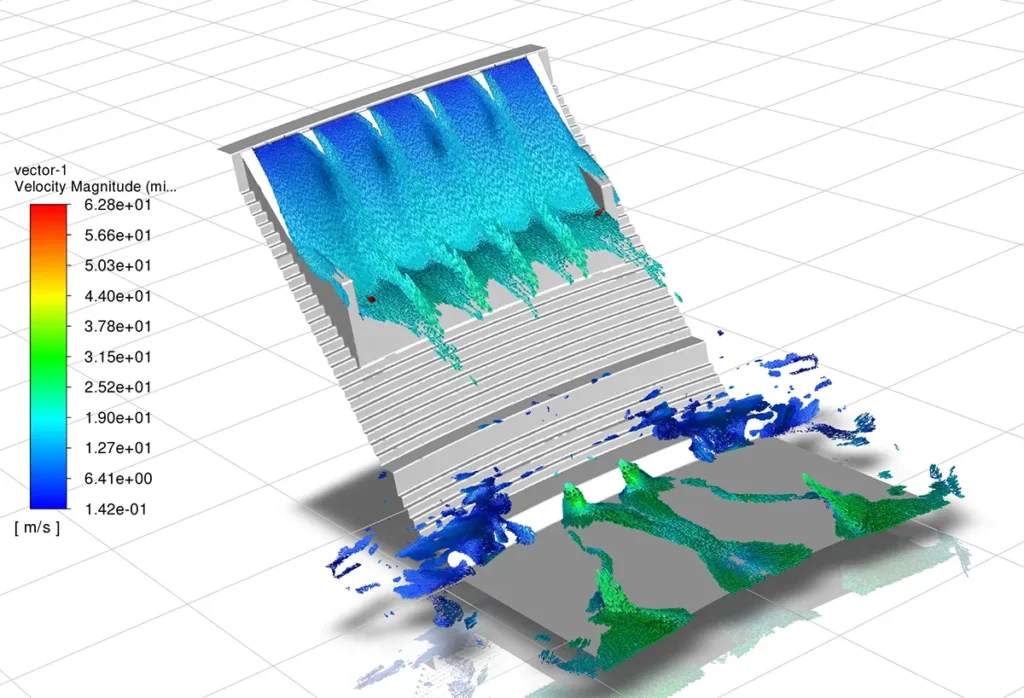
This project involved the development of a three-dimensional CFD model of the Ghadrooni Dam reservoir to predict water circulation patterns and evaluate how wind-driven airflow influences reservoir hydrodynamics. A Volume of Fluid (VOF) approach was used to represent the air–water interface, while the k-ω SST turbulence model was applied to resolve the turbulent flow behavior under the investigated operating conditions.
The simulation showed that airflow over the reservoir surface had a significant influence on the internal water circulation, changing the direction and strength of recirculation zones throughout the reservoir. These results provided practical insight into how atmospheric conditions can affect large-scale water movement rather than assuming the reservoir is controlled only by inlet and outlet flows.
This type of CFD analysis can support dam and reservoir engineering by improving understanding of circulation, mixing, stagnant regions, and transport behavior. Such information can assist engineers with water-management decisions, reservoir operation, environmental assessment, and the evaluation of hydraulic conditions that are difficult to measure comprehensively in the field.
Contact CFD Vision to discuss dam hydraulics, reservoir-flow analysis, or CFD simulation services for water systems.