
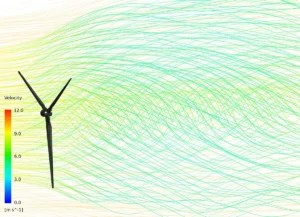
CFD simulation of a horizontal-axis wind turbine investigated blade loading, root and tip flow behaviour, and wake recovery for academic research into rotor aerodynamics.
Sector
Wind energy research
Client
University research group
Flow type
External rotating aerodynamic flow
Project Snapshot
Challenge
Rotor blades experience strongly three-dimensional flow: rotational effects near the root, tip vortices at the blade ends, and a wake that reduces the energy available to downstream turbines. Simplified blade-element methods cannot fully capture these effects, so resolved CFD is needed to study them reliably.
Approach
A 3D rotating CFD model of the full rotor resolved the blade surface pressure, the near-wake vortex structures and the downstream velocity field. Spanwise loading and wake velocity deficit were evaluated to relate blade aerodynamics to rotor performance and wake recovery.
Key Findings
- Most of the aerodynamic torque was generated on the outer part of the blade, while the root region showed flow separation and contributed little.
- Tip vortices formed a helical structure in the near wake and reduced loading close to the blade tips.
- The velocity deficit recovered gradually through mixing with the freestream, and the recovery distance gives a basis for assessing turbine spacing.
Deliverables
Blade pressure distributions, spanwise loading, near-wake vortex visualisations and wake-recovery analysis supporting academic wind-turbine research.
Working on a similar problem?
Explore our CFD consulting services and engineering simulation services, or send us your wind-turbine research or aerodynamic question.