
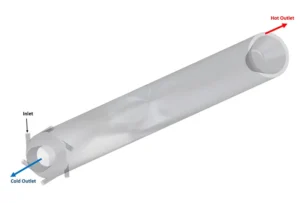
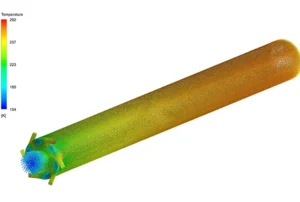
CFD simulation of a Ranque-Hilsch vortex tube resolved the swirling compressible flow that splits compressed air into hot and cold streams, and identified the geometric and operating factors that control separation performance.
Sector
Compressed-air and industrial cooling equipment
Client
Industrial cooling equipment developer
Flow type
Compressible swirling flow
Project Snapshot
Challenge
A vortex tube has no moving parts, yet it produces hot and cold air streams from a single compressed-air supply. Its performance depends on a complex internal flow: an outer swirling stream moving toward the hot end and an inner reverse-flowing core leaving through the cold end. Predicting this flow reliably is difficult, and it is essential for improving the temperature separation and the cold-air output.
Approach
A 3D compressible CFD model resolved the inlet nozzle jets, the swirl chamber, the hot-end control valve and the cold orifice. A turbulence model suitable for strongly swirling flow was used, so that energy transfer between the peripheral and core streams was captured, and hot and cold outlet temperatures were evaluated at the operating pressure.
Key Findings
- The tangential nozzles created an intense free-to-forced vortex. Peripheral air was heated as it moved toward the hot end, while the reverse-flowing core cooled and exited through the cold orifice.
- Energy separation was driven by turbulent shear and work transfer between the core and peripheral layers, concentrated in the swirl region near the inlet.
- The hot-end valve setting (cold mass fraction) governed the balance between cold-outlet temperature and cold-air flow rate. The lowest cold temperature and the maximum cooling capacity occur at different settings.
- Nozzle geometry and cold orifice size strongly influenced swirl intensity and therefore separation performance.
Deliverables
Velocity, pressure and temperature fields, hot and cold outlet performance, and recommendations on geometry and operating settings.
Working on a similar problem?
Explore our CFD consulting services and engineering simulation services, or send us your your vortex tube or thermal separation device question.