
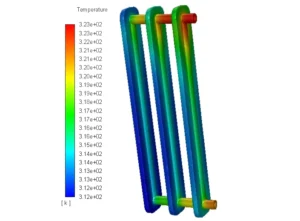
CFD analysis of radiator heating predicted room airflow, temperature stratification and cold-draught zones, showing how radiator placement affects thermal comfort in the occupied space.
Sector
Building heating and HVAC
Client
Heat exchanger manufacturer
Flow type
Natural convection and radiation
Project Snapshot
Challenge
A radiator heats a room through natural convection and radiation, so comfort depends on where the warm plume goes and how it interacts with cold surfaces such as windows and external walls. A poorly placed radiator can meet its heating capacity yet still leave cold floors, draughts and a warm layer trapped under the ceiling.
Approach
A room-scale CFD model with buoyancy and surface radiation resolved the radiator plume, air circulation and heat exchange with the walls and glazing. Temperature and air velocity in the occupied zone were evaluated against comfort criteria such as vertical temperature difference and draught.
Key Findings
- The warm plume rose to the ceiling and spread across it, creating vertical stratification with the warmest air above head height.
- Cold downdraught from the window formed a cool layer at floor level when it was not counteracted by the radiator plume, the main cause of local discomfort.
- Placing the radiator beneath the window offset the downdraught and gave a more uniform temperature in the occupied zone.
Deliverables
Room temperature and airflow maps, occupied-zone comfort assessment, and recommendations on radiator placement for building heating design.
Working on a similar problem?
Explore our CFD consulting services and engineering simulation services, or send us your radiator heating or building thermal question.