
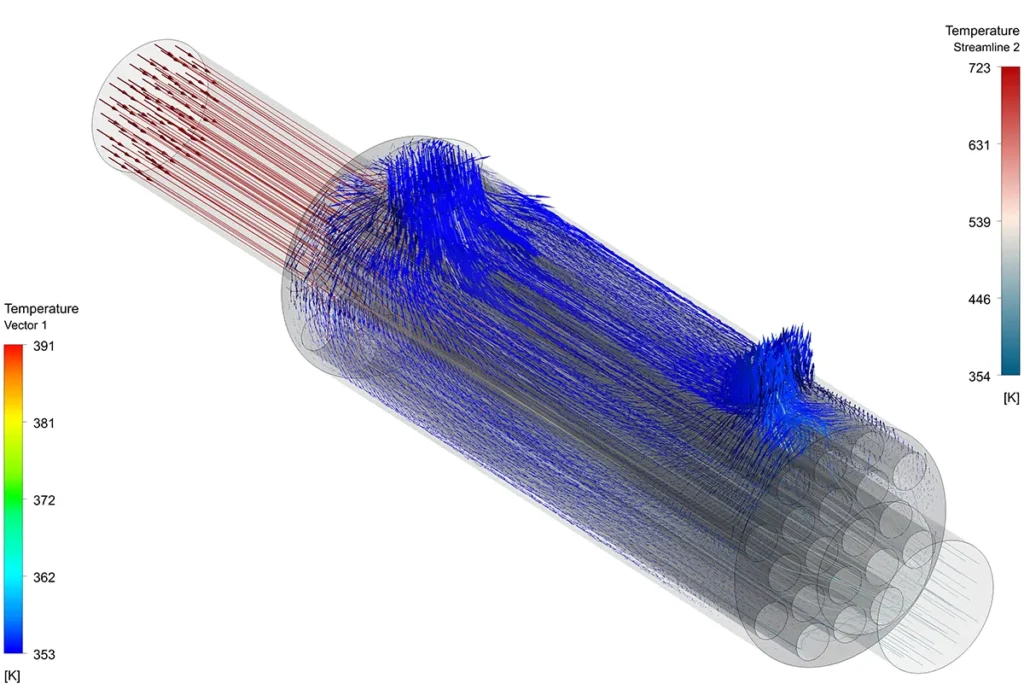
CFD analysis of an EGR cooler evaluated exhaust-gas cooling performance, flow distribution and coolant-side thermal risks, identifying design improvements for more uniform and reliable heat removal.
Sector
Automotive thermal systems
Client
Engine component manufacturer
Flow type
Hot gas and coolant, conjugate heat transfer
Project Snapshot
Challenge
An EGR cooler must bring hot exhaust gas down to a target temperature within tight pressure-drop limits. Uneven gas or coolant distribution creates cold spots, which reduce effectiveness, and hot spots, which raise the risk of local coolant boiling and thermal fatigue. The low-velocity gas regions that result are also where soot fouling tends to build up.
Approach
A conjugate heat transfer model resolved the exhaust-gas flow, coolant flow and wall conduction together. The cooler was assessed for gas outlet temperature, gas-side pressure drop, flow uniformity across the passages, and coolant-side wall temperatures in high-heat-flux regions.
Key Findings
- Inlet header geometry caused uneven gas distribution across the passages, which left some passages underused and reduced overall cooling effectiveness.
- The highest wall temperatures and heat fluxes occurred near the gas inlet. Coolant velocity there was critical for avoiding local boiling.
- Low-velocity coolant zones, particularly near the corners and baffles, were identified as hotspot risks.
- Improving inlet flow distribution was the most effective way to raise effectiveness without a proportional increase in pressure drop.
Deliverables
Gas and coolant velocity and temperature fields, wall temperature and heat flux maps, pressure-drop assessment, and design recommendations for header and passage distribution.
Working on a similar problem?
Explore our CFD consulting services and engineering simulation services, or send us your EGR cooler or engine thermal-management question.