
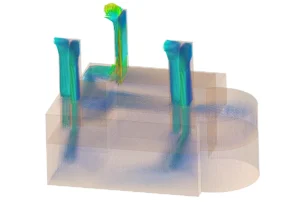
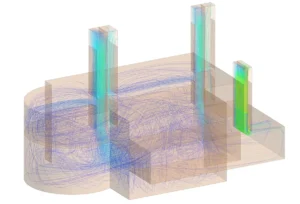
CFD simulation assessed how wind speed and direction drive airflow through a traditional windcatcher, and identified the design features that most affect its passive ventilation and cooling performance.
Sector
Sustainable building design
Client
Building engineering consultancy
Flow type
External wind-driven natural ventilation
Project Snapshot
Challenge
A windcatcher has no fans, so its ventilation rate depends entirely on the pressure differences created by the wind around the tower. Changing wind direction, flow separation at the tower edges, and short-circuiting between openings can significantly reduce the airflow delivered to occupied spaces. The design needed to be evaluated across realistic wind conditions rather than a single ideal case.
Approach
A 3D CFD model of the windcatcher and surrounding building, set in an atmospheric boundary-layer wind profile, was used to predict the external pressure field and the resulting airflow through the tower channels. Performance was compared across wind incidence angles to identify how well each opening supplied or extracted air.
Key Findings
- The windward opening captured positive pressure and supplied air, while the leeward and side openings sat in suction regions and extracted air. Together these formed a continuous ventilation loop through the building.
- Performance was sensitive to wind angle. At oblique incidence, part of the incoming air short-circuited between adjacent channels instead of reaching the occupied space, which showed where internal partitions and opening orientation matter most.
Deliverables
External airflow and pressure fields, supply and extract performance by opening, and design recommendations for windcatcher orientation, openings and internal partitioning.
Working on a similar problem?
Explore our CFD consulting services and engineering simulation services, or send us your your windcatcher or passive-ventilation question.