
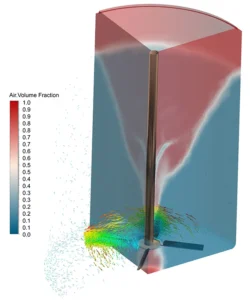
VOF-based CFD simulation of a pharmaceutical mixing tank compared impeller designs by circulation pattern, dead-zone extent and free-surface behaviour, supporting a more uniform and repeatable batch mixing process.
Sector
Pharmaceutical processing
Client
Pharmaceutical manufacturer
Flow type
Multiphase, turbulent, rotating flow
Project Snapshot
Challenge
Pharmaceutical batches must be mixed uniformly and repeatably, without excessive surface vortexing or air entrainment. The choice of impeller controls the circulation pattern, how quickly the whole vessel turns over and where poorly mixed dead zones form, but these differences are difficult to see in a closed vessel.
Approach
Transient VOF simulations with a rotating impeller were run for alternative impeller configurations. Each design was compared by free-surface shape, axial and radial circulation, and the size of low-velocity regions in the vessel.
Key Findings
- Radial-flow designs produced strong local circulation around the impeller but weaker exchange between the top and bottom of the vessel.
- Axial-flow designs improved top-to-bottom turnover, which is the key factor for batch homogeneity in tall vessels.
- Dead zones persisted near the vessel base and walls in some configurations, which showed where impeller position or clearance should be adjusted.
Deliverables
Free-surface and velocity visualisations, a comparative impeller assessment, dead-zone mapping and recommendations for the pharmaceutical mixing process.
Working on a similar problem?
Explore our CFD consulting services and engineering simulation services, or send us your pharmaceutical mixing or process-vessel question.