
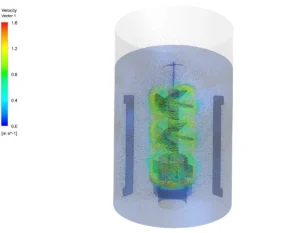
Multiphase CFD analysis of an unbaffled process mixing tank predicted free-surface vortex formation and bulk circulation around the impeller, and compared configurations for improving mixing performance.
Sector
Process engineering
Client
Industrial manufacturer
Flow type
Multiphase, turbulent, rotating flow
Project Snapshot
Challenge
Without baffles, an impeller tends to spin the liquid as a whole rather than mix it. The result is a deep central surface vortex, weak top-to-bottom exchange and a risk of air being drawn into the impeller. The vessel design had to deliver effective bulk mixing while keeping the free surface under control.
Approach
Transient VOF simulations with a rotating impeller resolved the liquid–air free surface and the internal circulation. Alternative mixing configurations were compared by vortex depth, axial circulation and the extent of poorly mixed regions in the vessel.
Key Findings
- In the unbaffled vessel, tangential flow dominated and the liquid rotated almost as a solid body, forming a deep central vortex.
- Axial circulation between the upper and lower regions was weak, leaving slow-mixing zones near the base and close to the surface.
- Configurations that broke up the swirl converted rotational motion into axial circulation, reducing vortex depth and the risk of air entrainment.
Deliverables
Free-surface and velocity fields, circulation and vortex assessment for each configuration, and design recommendations for the mixing vessel.
Working on a similar problem?
Explore our CFD consulting services and engineering simulation services, or send us your process mixing or multiphase-flow question.