
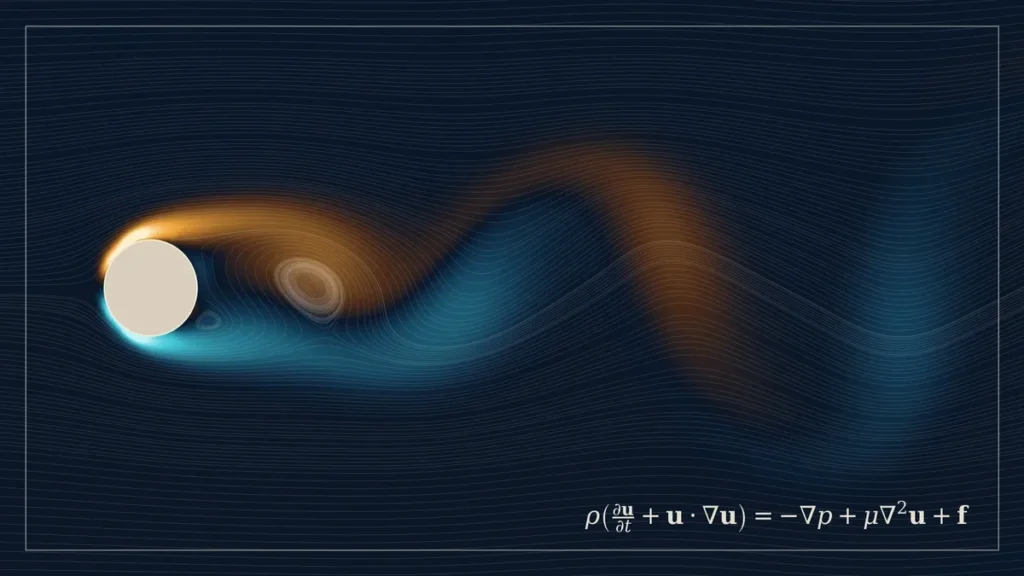
In short: on 8 September 2026, OpenAI announced a machine-generated proof, checked in the Lean proof assistant, of Navier-Stokes blow-up: the three-dimensional equations can develop a singularity in finite time when a carefully engineered smooth force drives the flow. Mathematicians are still examining the claim, and the version without any external force remains open. For engineers, the result does not undermine CFD. Instead, it sharpens three lessons we already rely on: the continuum is a model, a diverging simulation is almost never physics, and a verified answer is not automatically a validated one.
Every commercial and open-source CFD solver, from Ansys Fluent to OpenFOAM, approximates the equations that Claude-Louis Navier and George Stokes wrote down in the nineteenth century. Yet, despite two centuries of engineering success, mathematicians could not say whether those equations always behave. In 2000, the Clay Mathematics Institute therefore made the question one of its seven Millennium Prize Problems, with a US$1 million reward: can a smooth, finite-energy flow of an incompressible fluid develop infinite velocity gradients in finite time?
This September, the question suddenly moved from seminar rooms to newspaper headlines. OpenAI said an internal multi-agent system had produced a 166-page proof, together with a Lean formalisation, of finite-time blow-up for the forced equations. According to Quanta Magazine, around 10,000 autonomous AI agents worked on the problem for roughly 88 hours. Shortly afterwards, the Clay Institute acknowledged that the problem had “apparently been settled”, but it also stressed that its review would be deliberately unhurried, and it now lists the problem as active rather than solved.
What the Navier-Stokes Blow-Up Claim Actually Covers
Charles Fefferman’s official problem statement offers four ways to win. Two of them, statements (A) and (B), ask for a proof that smooth solutions exist forever, either in all of space or in a periodic box, with no external force. The other two, statements (C) and (D), ask for the opposite: a smooth start that breaks down in finite time, and here the rules allow a smooth external force. OpenAI’s construction targets (C) and (D), so it would formally settle the prize problem if it survives review. However, it says nothing about whether a fluid left entirely to itself can blow up, and most specialists regard that as the physically important question.
OpenAI also announced a separate result: blow-up for the inviscid Euler equations from smooth initial data with no forcing at all. Moreover, neither result appeared in a vacuum. Diego Córdoba and Luis Martínez-Zoroa had spent years building singularities from cascades of vortex layers, Jiajie Chen and Thomas Hou had already proved blow-up for Euler flow in a domain with a boundary using computer-assisted analysis, and, one day before OpenAI’s announcement, Levent Alpöge and Tristan Buckmaster posted Lean-verified, AI-assisted proofs of blow-up with smooth forcing for the 3D Euler equations and two related models. As a result, researchers are now debating credit in public, and any fair summary has to keep that context in view.
| Question | Status in October 2026 |
|---|---|
| Navier-Stokes with a smooth external force (Clay statements C and D) | Blow-up claimed by OpenAI; expert review ongoing |
| Euler equations, smooth data, no force | Blow-up claimed by OpenAI; expert review ongoing |
| Navier-Stokes with no external force (Clay statements A and B) | Open |
| Euler equations in a domain with a boundary | Blow-up proved by Chen and Hou with computer-assisted analysis |
Vortex Stretching: The Mechanism Every CFD Engineer Already Knows
The physics behind a possible singularity is surprisingly familiar. In three dimensions, a vortex tube that gets stretched along its axis spins faster as it thins, much like a figure skater pulling in their arms. In the vorticity form of the equations, the term (ω·∇)u describes exactly this amplification. Consequently, rotation can feed on itself: stronger vorticity creates stronger strain, which stretches the vorticity further.
Mathematically, this feedback resembles the simple equation y′ = y², whose solution races to infinity in finite time. Viscosity, in contrast, smooths gradients, and the whole Clay problem asks which effect wins at ever-smaller scales. Notably, two-dimensional flows lack the stretching term entirely, which is why mathematicians proved long ago that smooth 2D flows stay smooth. For CFD engineers, this is no abstract curiosity, because vortex stretching drives the turbulent energy cascade and explains why turbulence modelling remains the hardest part of most simulations.
The new construction exploits that mechanism with extreme precision. Researchers who have studied it describe an axisymmetric swirling core, spun up by inward radial flow and drained along its axis, while an oscillatory force supplies the momentum the core would otherwise lack. In other words, the force is not a fan, a pump or gravity; instead, it is a mathematically tailored input with structure on ever-finer scales.
Why Your CFD Model Will Never Meet This Singularity
Engineers can therefore read the news with interest rather than alarm, for three practical reasons.
1. Real fluids stop being a continuum first
A singularity requires velocity gradients to concentrate into a region that shrinks towards zero. Real fluids, however, consist of molecules. In air at sea level, molecules travel only about 70 nanometres between collisions, so the continuum assumption behind the Navier-Stokes equations starts to fail long before any gradient becomes infinite. Meanwhile, in most industrial flows the smallest turbulent eddies, at the Kolmogorov scale, still measure tens of micrometres or more. Put simply, the model stops describing nature well before the mathematics breaks.
2. Engineering forces look nothing like the construction
The proof needs a force that is smooth yet intricately organised across scales. By contrast, the forces in an engineering model come from gravity, rotating machinery, fans or prescribed inlets, and none of them resembles that construction. Therefore, nothing in the result suggests that a pump, a heat exchanger or a wing will develop infinite velocities.
3. A finite mesh solves a regularised problem
Every CFD model works on a finite mesh with a finite time step, so it cannot represent an infinite gradient by construction. In addition, numerical schemes introduce dissipation, while RANS and LES models add modelled turbulent viscosity. As a result, CFD always solves a smoothed, regularised version of the equations. That property makes it robust for engineering decisions; equally, it explains why simulation alone could never settle the Clay problem, and why Chen and Hou needed rigorous computer-assisted error bounds rather than ordinary numerics.
When a Simulation Blows Up, Suspect the Numerics First
Ironically, most CFD engineers have watched a solution “blow up” on screen: residuals spike, velocities climb to absurd values, and the solver crashes. That event is almost always numerical, not physical. Typical culprits include:
- a time step too large for the local cell size, which a quick Courant-number check exposes;
- highly skewed or stretched cells in regions with steep gradients;
- boundary conditions that conflict, or that switch on too abruptly;
- stiff source terms from combustion, phase change or porous media without enough under-relaxation;
- higher-order schemes started from a poor initial field.
In practice, the remedy is diagnosis, not a bigger computer: reduce the time step, repair the mesh, ramp the boundary conditions, and start with robust first-order schemes before switching to higher-order ones. Our y+ first-cell height calculator and GCI mesh independence calculator help you set up and check the mesh, while our guide to CFD validation explains how to confirm that a converged result is also a correct one.
The Deeper Lesson: Verified Is Not the Same as Validated
For engineers, the most useful idea in this story concerns checking, not singularities. Lean is a proof assistant that mechanically checks every logical step of a formal statement. That check is extremely strong, yet it only confirms that the formal conclusion follows from the formal assumptions. Accordingly, someone still has to confirm that the formal statement says what the mathematicians meant. In a recent preprint, Bastounis, Circelli and Hansen argue that parts of the Lean formalisation do not match the natural-language proof. Whether or not their critique holds up, it highlights a gap that the CFD community knows well.
In CFD, verification asks whether we solved the equations correctly: converged, mesh-independent and conservative. Validation then asks whether we solved the right equations for the physical problem. A flawless mesh study cannot rescue an unsuitable turbulence model, just as a flawless formal check cannot rescue a mistranslated theorem. The same discipline now applies to AI-assisted CFD more broadly, because tools that build meshes, set up cases or write reports in minutes still need an engineer to confirm that the output answers the real question.
What This Means for Engineering Teams
- Keep using CFD with confidence, since engineering simulation rests on validated approximations rather than on the outcome of the Clay problem.
- Treat a crashing or exploding solution as a numerical symptom to diagnose, not as a physical prediction.
- Apply the same verification and validation discipline to AI-generated setups, meshes and reports.
- Watch the mathematics, because a better understanding of how vortex stretching concentrates energy may eventually inform turbulence and subgrid models for extreme events.
Ultimately, the unforced problem is still open, so the most important question about real fluids has not changed. What has changed is the pace. Machine-assisted mathematics has arrived in fluid dynamics, and engineers should expect it to reach modelling, numerics and design tools next.
Frequently Asked Questions
Has the Navier-Stokes Millennium Prize problem been solved?
Not definitively. OpenAI’s proof targets the forced statements in the official problem, and the Clay Mathematics Institute has said the problem appears settled while it conducts a deliberately slow review. OpenAI has also said it will not claim the prize. Meanwhile, the unforced question remains open.
Does Navier-Stokes blow-up mean CFD results are wrong?
No. The construction relies on a specially engineered force and on scales far below the point where real fluids behave as a continuum. CFD solves regularised, discretised equations, and its reliability comes from verification and validation against measurements.
Why does the external force matter so much?
A force can keep injecting energy and structure into the flow. Without it, viscosity only removes energy, so proving blow-up becomes far harder. For that reason, most mathematicians regard the unforced case as the physically meaningful one.
Can CFD detect a finite-time singularity?
Not on its own. High-resolution simulations can point to candidate blow-up scenarios, as the earlier Luo and Hou computations did, but turning a candidate into a proof requires rigorous error control, often through computer-assisted analysis.
For the primary sources, see OpenAI’s announcement, the Clay Institute’s problem statement, and the guest post by Córdoba and Martínez-Zoroa on Terence Tao’s blog, which places the new work within decades of human research.
Need simulation results you can defend? CFD Vision delivers CFD consulting and simulation services built on careful numerics and honest validation, from thermal and fluid flow analysis to simulation-driven product development. If your team wants to understand what its solver is really doing, our CFD training covers the numerics behind the results. Otherwise, you can contact CFD Vision to discuss your project.
About the author: Ryan Mozafari leads CFD Vision. He holds a PhD in thermal-fluid science from Macquarie University and has more than 10 years of experience applying CFD to industrial and academic problems. LinkedIn · Google Scholar