
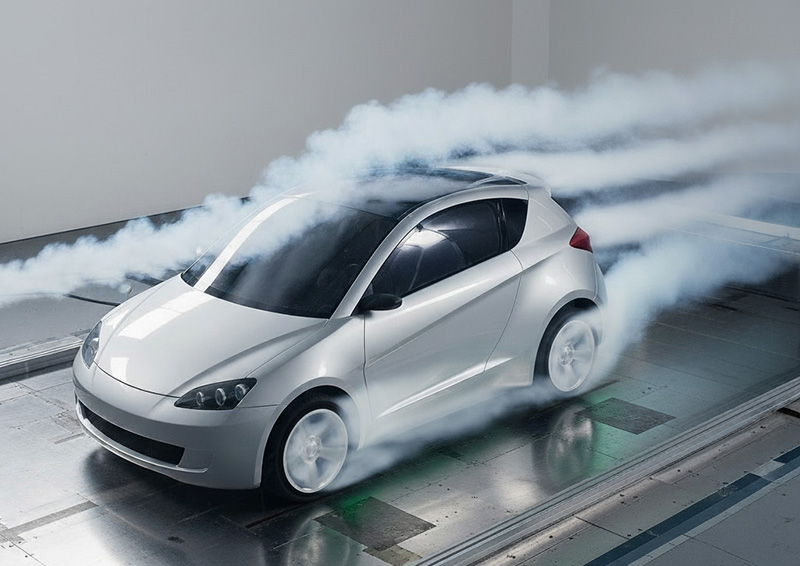
In short: the new Tesla Roadster uses two separate fluid systems. First, fans pull air from beneath a sealed floor, so atmospheric pressure presses the car onto the road, or onto a ceiling, even at standstill. Second, cold gas thrusters release stored high-pressure gas through nozzles, which produces thrust without combustion. Because the gas supply is finite and its pressure falls as it empties, the thrusters can only deliver flight in bursts of seconds. That is why the demo looked like a series of jumps and controlled landings rather than sustained flight.
On 15 October 2026, Tesla finally revealed the second-generation Roadster at SpaceX’s test site in McGregor, Texas. In front of a live crowd, a driverless prototype climbed a curved ramp until it hung upside down, then left the ramp, rolled itself upright on jets of gas and landed on its wheels. Next, it leapt over a line of parked Teslas with a mid-air flip, as CNBC reported. The spectacle grabbed the headlines. However, the physics underneath is more interesting than the stunt, because almost every trick relies on classic fluid dynamics: compressible nozzle flow, high-pressure gas storage, jet behaviour and suction-based downforce.
What Tesla Showed at the Roadster Reveal
Tesla now offers the Roadster in three configurations, and each one adds another fluid system. According to Tesla’s Roadster page and the specifications Teslarati compiled, the line-up looks like this:
| Version | Seats | Fluid systems | Claimed 0 to 60 mph |
|---|---|---|---|
| Performance | 2 | Active aerodynamics and a fan-driven suction system | Under 1.6 s |
| Thrust | 2 | Adds rear cold gas thrusters | Under 0.9 s |
| Rocket | 1 | Adds perimeter thrusters for lift and rotation | Under 0.59 s |
In an engineering walkthrough with Hagerty, Tesla’s vice president of vehicle engineering, Lars Moravy, explained that a 200-litre gas tank behind the seats feeds the rear thrusters. In the Rocket version, a second 400-litre tank replaces the passenger seat. He also said the fans can pull the car down with up to twice its own weight. Tesla, meanwhile, notes that the car is not yet approved for public road use. With those facts in hand, we can look at how each system actually works.
How a Cold Gas Thruster Produces Thrust
A cold gas thruster is the simplest rocket engine there is. Essentially, a valve opens, stored gas accelerates through a nozzle, and the reaction force pushes the vehicle the other way. No fuel burns, so the jet carries no flame. Spacecraft have used this principle for decades, and NASA’s small spacecraft technology report lists gaseous nitrogen as the most common propellant, valued for its simplicity and safety.
The thrust equals the mass flow rate multiplied by the exhaust velocity, plus a pressure term at the nozzle exit. Consequently, designers can raise thrust in only two ways: push more gas through, or push it out faster. Mass flow depends mainly on tank pressure and throat area. Once the tank pressure exceeds roughly 1.9 times the outside pressure, the flow in the narrowest section reaches the speed of sound and becomes choked, as NASA Glenn’s guide to mass flow choking explains. From that point, mass flow rises in direct proportion to the tank pressure. At thousands of psi, therefore, a small throat can pass tens of kilograms of gas per second.
Exhaust velocity, by contrast, has a hard ceiling. A cold gas has only its stored thermal energy to convert into motion. Even with a perfect nozzle, nitrogen at room temperature cannot exceed roughly 780 m/s, and real systems reach less. That is why NASA quotes a specific impulse of only about 40 to 110 seconds for cold gas systems, far below combustion rockets.
Why thrusters beat tyres off the line
Every conventional car hits the same wall: tyre grip. Even the stickiest tyres struggle to push a car much beyond about 1.5 g. Thrusters, however, do not need grip, because they push against the gas they eject rather than against the road. Tesla claims its thruster system generates four to five times the force the tyres can. The onstage figure supports a big number: 0 to 60 mph in 0.81 seconds equals an average acceleration of about 3.4 g. For comparison, that is roughly double what the best tyre-limited electric hypercars achieve.
Why the Roadster Flies for Seconds, Not Minutes
Hovering demands that thrust equals weight, and that requirement drains the tank quickly. Tesla has not published the car’s mass, so take an illustrative range of 1,500 to 2,000 kg. In that case, the thrusters must produce about 15 to 20 kN just to hold the car in the air. With an effective specific impulse of 60 to 70 seconds, that thrust consumes roughly 21 to 33 kg of gas every second.
Reports put the stored gas at around 260 kg, which is consistent with about 600 litres at several hundred bar. Divide one by the other, and the theoretical hover time comes out at roughly 8 to 12 seconds. In reality, the figure is lower, for three reasons:
- Blowdown: as gas leaves, tank pressure falls, so mass flow and thrust fall with it. Below a certain pressure, the thrusters can no longer lift the car at all, so the last part of the gas is effectively unusable for flight.
- Expansion cooling: the gas left in the tank expands quickly and cools sharply. Since exhaust velocity scales with the square root of gas temperature, a colder tank also gives weaker thrust per kilogram.
- Control margins: the car needs reserve thrust to correct its attitude and soften the landing, so it cannot spend every kilogram on lift.
The demo reflected this budget precisely. Instead of hovering, the car used momentum from the ramp or the launch for most of each arc and fired the thrusters in short, controlled pulses to rotate and land. In fact, that is how SpaceX uses cold gas on its rockets too: small, precise attitude corrections rather than primary propulsion.
Storing Gas at Extreme Pressure
Years ago, Musk described the system as air or nitrogen stored at around 10,000 psi, about 690 bar, in a composite overwrapped pressure vessel (COPV). A COPV combines a thin metal or polymer liner with a carbon-fibre wrap that carries most of the load, so it stores far more gas per kilogram of tank than steel. Tesla now says it packs these carbon-fibre-wrapped tanks into every spare cavity, because more stored gas means more flight time.
Such tanks hold an enormous amount of stored energy, so their design leaves little room for error. Indeed, NASA’s engineering safety centre calls COPVs deceptively complex, since fibre stress rupture, liner fatigue and impact damage all demand careful analysis. A road car adds new loads that spacecraft rarely see, such as kerb strikes, crash energy and years of vibration. Musk himself warned before the event that the demo could be “a banger”, perhaps literally, and later said the car is not optimised for safety.
Refilling raises another thermodynamic question. Tesla says an onboard compressor refills the tanks, so owners need no special propellant. However, compressing gas to hundreds of bar generates a lot of heat, and the pressure drops again as the gas cools back to ambient temperature. Multi-stage compression with intercooling reduces the energy cost, yet it still takes time and electrical energy. So far, Tesla has not said how long a full refill takes. The choice of gas matters too. Nitrogen is dry and inert, whereas compressed air carries moisture that can freeze inside valves and nozzles during rapid expansion. Tellingly, Tesla describes the propellant as compressed air, while Hagerty’s walkthrough refers to nitrogen.
Why the Plumes Look White and Sound So Loud
The white plumes are not smoke. As the gas accelerates through the nozzle, its static temperature plunges far below freezing. As a result, the cold jet chills the surrounding air below its dew point, and water vapour condenses into a visible fog. The same effect creates the cloud around a fire extinguisher discharge or a high-pressure air leak.
Noise follows from jet speed. When a nozzle releases gas at a pressure higher than the surrounding air, the jet leaves underexpanded and forms a chain of shock cells, often called shock diamonds, which add a sharp, crackling component. On top of that, Lighthill’s classic acoustic analogy shows that the sound power of a turbulent jet rises roughly with the eighth power of its velocity. Even a modest increase in jet speed therefore makes the jet dramatically louder, which explains why Tesla handed earplugs to its guests.
Driving on the Ceiling: Fan Suction and Ground Sealing
The upside-down climb did not use the thrusters at all. Instead, it relied on suction, an idea with a famous past. In 1970, the Chaparral 2J raced in Can-Am with two rear fans, driven by a separate two-stroke engine, that pulled air from beneath the car while plastic skirts sealed the gap to the track. Similarly, the Brabham BT46B won its only Formula 1 race in 1978 with a fan before Brabham withdrew it. Both cars proved the principle so convincingly that the rule makers banned them.
The physics is simple. Downforce equals the pressure drop under the floor multiplied by the floor area. Unlike a wing, whose downforce grows with the square of speed, a fan creates the same suction at 5 km/h as at 200 km/h. That is the key to sticking to a wall at walking pace. Consider an illustrative 1,800 kg car with 4 m² of sealed floor. To pull it down with twice its own weight, the fans need a pressure drop of only about 8.8 kPa, less than a tenth of atmospheric pressure. Upside down, the requirement halves, since the suction only has to exceed the car’s weight.
The real engineering challenge, then, is the seal rather than the suction. Any gap between floor and ground lets air rush in, and the fan must continuously pump that leakage out. With the same assumptions, a 5 mm gap around a 10 m perimeter would let in air at more than 100 m/s, a leakage of roughly 3.6 m³/s. Pumping that against 8.8 kPa demands around 50 kW of fan power. Halve the gap, and the power falls sharply. For this reason, Tesla’s system pairs the fans with active ground sealing, and the car’s ride height, skirt design and fan control must all work together over bumps, kerbs and ramp transitions.
What the Demo Did Not Answer
Tesla timed every run itself, on a closed site, with no one inside the car. Several engineering questions therefore remain open. How long does a full gas refill take, and how much energy does it use? How many seconds of thrust does a full tank really deliver? What happens if one thruster fails during a rotation? How do the fan seals cope with real roads, debris and rain? Finally, which regulator will ever certify a road car that stores hundreds of litres of gas at hundreds of bar? Production is due to start in 2028, so Tesla still has time to answer them.
Where Simulation Fits
Systems like these sit squarely in the territory of computational fluid dynamics. For instance, engineers use simulation to size nozzles for choked, underexpanded flow, to predict how thrust decays during a transient tank blowdown, and to estimate leakage and fan power under a sealed floor long before building hardware. The same methods apply well beyond hypercars, from compressed-gas safety systems and pneumatic actuators to fans, ducts and vehicle aerodynamics. As experienced CFD consultants, CFD Vision delivers this kind of thermal and fluid flow analysis for clients worldwide, as well as CFD consulting in Australia.
Frequently Asked Questions
How do the Tesla Roadster’s thrusters work?
They are cold gas thrusters. Valves release high-pressure gas from carbon-fibre-wrapped tanks through nozzles, and the reaction force pushes the car. Rear thrusters add acceleration, while perimeter thrusters in the Rocket version provide lift and rotation.
Do the Roadster’s thrusters burn rocket fuel?
No. The thrusters release compressed gas without combustion, so they produce no flame or hot exhaust. Tesla says an onboard compressor refills the tanks, although it has not said how long a refill takes.
How long can the Tesla Roadster fly?
Tesla has not published a flight time. A simple momentum estimate suggests that a full tank could support roughly 8 to 12 seconds of hovering in theory, and less in practice, because thrust falls as tank pressure drops. The demo therefore used short bursts for jumps, rotations and landings.
How can the Roadster drive upside down?
Fans extract air from beneath a sealed floor, so the outside air pressure pushes the car against the surface. According to Tesla, the suction can reach twice the car’s weight, which is more than enough to hold it on a ceiling, even when stationary.
Is the flying Tesla Roadster road legal?
Not yet. Tesla notes that the car is not approved for public road use, and the Rocket version is not available in all regions. Production is planned for 2028.
Working on high-pressure gas flow, nozzles, fans or vehicle aerodynamics? CFD Vision provides CFD simulation services and product development support to answer those questions before you build hardware. Explore our CFD simulation projects, build in-house skills with CFD training, or contact CFD Vision to scope your project.
About the author: Ryan Mozafari leads CFD Vision. He holds a PhD in thermal-fluid science from Macquarie University and has more than 10 years of experience applying CFD to industrial and academic problems. LinkedIn · Google Scholar