
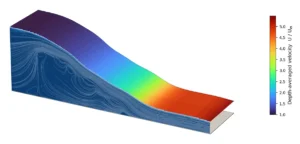
CFD simulation examined water flow through and over a rock-filled gabion, quantifying its hydraulic resistance, upstream water-level rise and the downstream flow conditions that affect stability and scour.
Sector
Hydraulic engineering
Client
Civil and water infrastructure consultancy
Flow type
Free-surface and porous-media flow
Project Snapshot
Challenge
Gabions are used for weirs, channel protection and erosion control because water can pass through the rock fill while energy is dissipated. Their performance depends on how flow divides between seepage through the rock and overflow across the crest, which controls the upstream water level and the downstream velocities that drive scour.
Approach
A free-surface CFD model coupled the open-channel flow with a porous-media representation of the rock fill, using resistance coefficients based on rock size and porosity. Flow entering, passing through and leaving the gabion was resolved to evaluate head loss, flow partitioning and downstream velocities.
Key Findings
- The rock fill created significant resistance, raising the upstream water level and dissipating energy as flow passed through the structure.
- Flow concentrated through the lower-resistance paths within the gabion, so porosity and rock grading directly controlled its hydraulic performance.
- Flow re-emerging at the downstream face formed a higher-velocity zone near the toe, which identified where scour protection is most needed.
Deliverables
Velocity, pressure and water-surface profiles, head-loss assessment through the gabion, and recommendations on rock fill and downstream protection.
Working on a similar problem?
Explore our CFD consulting services and engineering simulation services, or send us your porous hydraulic structure question.