
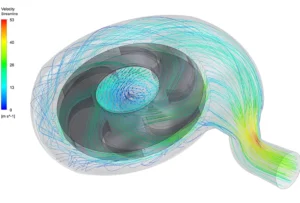
CFD simulation of a centrifugal fan evaluated pressure rise, internal losses and outlet flow quality, and located the impeller and volute features limiting efficiency.
Sector
Industrial ventilation
Client
Industrial fan manufacturer
Flow type
Rotating, turbulent air flow
Project Snapshot
Challenge
A centrifugal fan’s efficiency and noise depend on how smoothly air turns into the impeller, gains energy along the blades and is collected by the volute. Separation at the inlet, recirculation near the volute tongue and a non-uniform outlet all waste energy, but they are difficult to locate from performance testing alone.
Approach
A 3D rotating model of the inlet, impeller and volute was solved with a turbulence model suited to separated internal flow. Pressure rise and losses were evaluated at the operating point, and velocity, pressure and recirculation were traced through each component to identify where energy was lost.
Key Findings
- Inflow turning into the impeller eye was uneven, which loaded some blade passages more heavily than others and reduced overall efficiency.
- Recirculation formed near the volute tongue, where the flow changes direction sharply. This was the main loss region and a likely source of tonal noise.
- Interaction between the rotating impeller discharge and the stationary volute produced a skewed outlet profile, which pointed to tongue clearance and volute shape as the key areas for improvement.
Deliverables
Velocity and pressure fields, loss breakdown by component, outlet flow assessment and design recommendations for the impeller inlet and volute.
Working on a similar problem?
Explore our CFD consulting services and engineering simulation services, or send us your centrifugal fan or rotating-equipment question.