
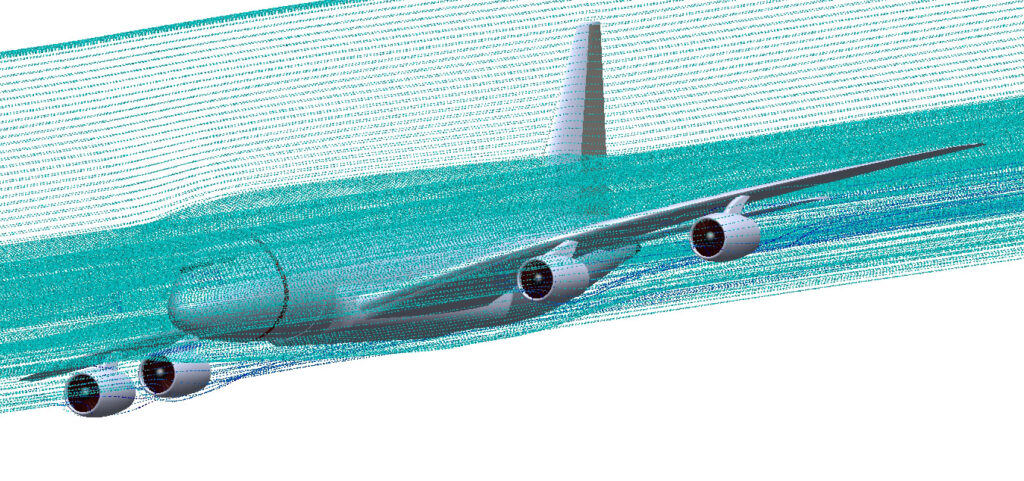
Surface pressure and airflow around a commercial aircraft configuration
External aerodynamics study of a commercial aircraft, examining how the wing, fuselage and wake interact and where lift and drag are generated.
Sector
Aviation
Client
University research group
Flow type
External, compressible, 3D
Project Snapshot
Challenge
Aircraft performance depends on the interaction between wing, fuselage, nacelles and tail. Interference at junctions such as the wing root can add drag and trigger local separation that a wing-only analysis misses.
Approach
A full 3D external-flow simulation of the aircraft with compressibility effects, mesh refinement on the wing, junctions and wake, and a turbulence model suited to attached and mildly separated flow.
Key Findings
- The wing upper surface carried the strongest suction, with pressure recovery toward the trailing edge governing separation risk.
- Wing–fuselage and nacelle junctions showed local flow disturbances that contribute to interference drag.
- Wing-tip vortices dominated the wake, linking directly to induced drag.
Deliverables
Surface pressure and velocity fields, wake and vortex visualization, and regions flagged for geometric refinement. Read more about aerodynamic performance analysis with CFD simulation.
Working on a similar problem?
Explore our CFD consulting services or send us your aerospace aerodynamics question. Learn more about our computational fluid dynamics consulting in Australia.