
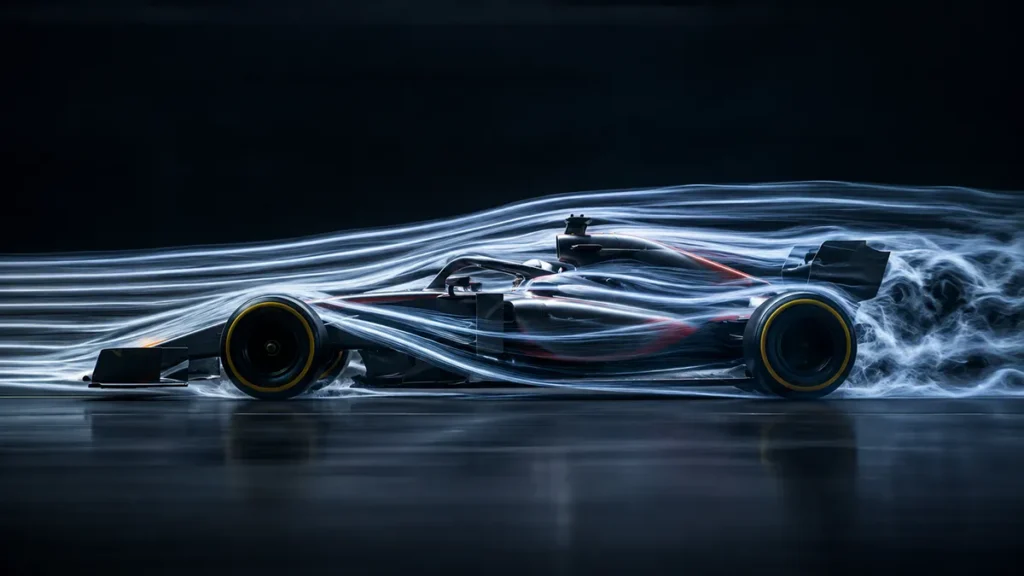
In short: F1 CFD restrictions cap every team’s aerodynamic development. In each roughly two-month testing period, the baseline allowance is 320 wind tunnel runs and 2,000 CFD geometries, plus a computing limit, scaled from 70% for the champion to 115% for the last-placed team. The 2026 rules then added active front and rear wings, so teams must now develop two aerodynamic states within the same budget. The way they spend that ration offers a practical playbook for any engineering team that runs CFD against a deadline.
In most companies, the limit on CFD is money, software licences or a delivery date. In Formula 1, the rulebook sets the limit. The FIA has capped aerodynamic testing for years, and since 2021 a sliding scale has metered every team’s wind tunnel runs, CFD geometries and even processor hours, giving the most to the teams that perform worst. Consequently, F1 has become the world’s most competitive experiment in rationed simulation, and its lessons reach far beyond motorsport.
How F1 CFD Restrictions and Aerodynamic Testing Limits Work
The Aerodynamic Testing Restrictions (ATR) divide each season into six aerodynamic testing periods, three in each half of the year. In every period, the team in seventh place in the Constructors’ Championship receives the baseline: 320 wind tunnel runs and 2,000 CFD items, where an item is essentially one geometry submitted for simulation. On top of the item count, the FIA limits computing power in Mega Allocation Unit hours (MAUh), a figure based on processor cores, clock speed and solver wall-clock time.
Each team’s share then slides with championship position in 5% steps, and the allocations reset on 1 January and 1 July using the latest standings, as Formula 1 explains:
| Constructors’ position | Share of baseline | Wind tunnel runs per period | CFD items per period |
|---|---|---|---|
| 1st | 70% | 224 | 1,400 |
| 4th | 85% | 272 | 1,700 |
| 7th | 100% | 320 | 2,000 |
| 10th or new entrant | 115% | 368 | 2,300 |
In practice, the 2025 champion entered 2026 with 30% less development capacity than a midfield team, while the new Cadillac team received the maximum allowance, according to The Race. The rules also froze the starting line of the new era: teams could not run any CFD or wind tunnel tests on 2026-style geometry before 1 January 2025. Add a cost cap, and every simulation has to earn its place.
Why 2026 Made the CFD Budget Even Tighter
The 2026 technical regulations reset the cars more deeply than any change in years. According to the FIA, the wheelbase shrank to 3,400 mm, downforce fell by up to around 30% and drag by roughly 55%, and active aerodynamics arrived on both the front and rear wings. In Straight Mode, the wing flaps open on designated straights to shed drag; in Corner Mode, the default state, they close to restore downforce. Unlike the old DRS, the system mainly serves energy efficiency, because the new power units rely far more on electrical energy.
For aerodynamicists, that one change multiplies the work. Each car now has at least two aerodynamic configurations that must both perform well, and the transition between them matters too. When the driver brakes, the wings return to Corner Mode automatically, as Gary Anderson explains, so the aerodynamic balance shifts at the very moment the car is most sensitive to it. Furthermore, the wings interact with the wheel wakes, the floor and each other differently in each state. Yet the item and MAUh limits did not double, so teams must extract roughly twice the insight from the same ration.
Six Habits for Spending a Rationed CFD Budget
Teams guard their methods closely. Still, the constraints push every competent aero department towards the same engineering habits, and none of them is unique to motorsport.
1. Make every run answer a decision
A CFD item that merely “takes a look” is wasted. Before submitting a geometry, the engineer should know which number will decide the next step, whether that is front-wing load in Corner Mode or drag in Straight Mode. As a result, most useful simulations become comparisons between two options rather than open-ended explorations.
2. Screen cheaply, then refine
Low-cost models, such as coarser meshes, reduced domains or simplified physics, can rank dozens of concepts quickly. Afterwards, only the promising candidates move on to high-fidelity runs. The skill lies in knowing where the cheap model ranks designs correctly, even when its absolute numbers are off.
3. Let gradients and surrogates do the searching
An adjoint solution returns the sensitivity of a chosen output to every surface point for roughly the cost of one extra solve, so it shows where to change the shape before anyone draws a new geometry. Similarly, a well-planned set of runs can train a surrogate model that interpolates between geometries, which lets engineers explore the design space without spending an item on every idea.
4. Standardise the mesh and the process
When geometries differ by millimetres, a meshing inconsistency can hide or invent the very difference you want to measure. Automated, standardised meshing and solver settings therefore keep comparisons fair. In addition, a periodic mesh independence check confirms that the baseline resolution remains adequate as the design evolves.
5. Stop the solver at the right moment
Because MAUh grows with cores and wall-clock time, every unnecessary iteration consumes budget. Monitoring the forces that matter, rather than waiting for residuals to fall by an arbitrary amount, lets engineers stop a run as soon as the decision-relevant quantity has settled. Likewise, in industry, the same habit frees licence time and hardware for the next design.
6. Protect correlation above everything
A fast but wrong CFD answer costs more than no answer, because it sends development in the wrong direction. That is why teams keep correlating CFD against the wind tunnel and the tunnel against the track. When a car that looked strong in simulation disappoints on track, the fix almost always starts with better correlation rather than more simulation, which is the essence of CFD validation.
The Same Playbook Works in Industry
Most engineering companies face the same constraint in a different form. A product team might have budget for twenty high-fidelity simulations before a design freeze, not two hundred. Meanwhile, a consultant might have a fortnight to diagnose a cooling problem in a plant that cannot stop. In each case, the F1 approach applies: define the decision, screen cheaply, use sensitivities, standardise the process and validate the critical result. In practice, the biggest savings in product development and thermal and fluid flow analysis rarely come from faster hardware; instead, they come from asking a sharper question before the first mesh.
Equally, the F1 story shows why experience is the scarcest resource of all. Rules can ration compute, but they cannot ration judgement, and judgement decides which runs are worth doing. That is the real value of experienced CFD consultants: fewer, better-chosen simulations that lead to a confident decision.
For engineering teams in Australia, our CFD simulation services in Sydney apply the same principle: fewer, better-chosen simulations that lead to confident design decisions.
Frequently Asked Questions
What is a CFD item in Formula 1?
A CFD item is essentially one geometry that a team submits for aerodynamic simulation. The regulations limit the number of items in each testing period, and a separate compute cap limits how much processing power those simulations may use.
What does MAUh mean in F1?
MAUh stands for Mega Allocation Unit hours. It measures CFD computing use from the number of processor cores, their clock speed and the solver’s wall-clock time, so teams cannot dodge the item limit by simply running bigger simulations.
Why does the F1 champion get less aero testing?
The sliding scale aims to close the gap between teams. The champion receives 70% of the baseline allowance, while the last-placed team and new entrants receive 115%, and the scale resets twice a year.
How does active aero affect CFD development?
Active aero gives each car at least two aerodynamic states, plus the transition between them. Teams therefore need to evaluate far more configurations within the same item and compute limits, which rewards efficient simulation strategy.
Need answers from fewer, smarter simulations? CFD Vision provides CFD consulting and CFD analysis services for aerodynamic performance, thermal management and product development, with a simulation plan built around the decisions you need to make. Browse our CFD simulation projects or contact CFD Vision to scope your project.
About the author: Ryan Mozafari leads CFD Vision. He holds a PhD in thermal-fluid science from Macquarie University and has more than 10 years of experience applying CFD to industrial and academic problems. LinkedIn · Google Scholar